

· By Annemarie
What Happens When You Drink Alcohol A Journey Through Your Body
When you drink, that alcohol takes a lightning-fast tour through your body, and it doesn't miss a stop. The thing is, alcohol gets a VIP pass. Unlike food, it doesn't need to be broken down and digested. Instead, it gets absorbed directly into your bloodstream, mostly from the stomach and small intestine, and then it’s off to the races, visiting pretty much every organ you have—especially your brain and liver.
The whole experience, from the first buzz to the morning after, boils down to a simple race: how quickly you're drinking versus how fast your body can get rid of it.
The Journey of Alcohol From First Sip to Final Effect
Ever really thought about what’s happening inside your body after that first sip of a cocktail or beer? It’s not a slow, winding digestive process. Alcohol gets express shipping straight into your system.
Because it can travel so quickly through the bloodstream, you feel the effects on your brain—that sense of relaxation or the sudden urge to tell your friend you love them—way faster than you'd feel the energy from a meal.
The Absorption and Distribution Process
The moment that drink passes your lips, your body starts absorbing it. A tiny amount gets into your bloodstream right from your mouth and tongue. Then, once it hits your stomach, about 20% of the alcohol is absorbed through the stomach lining.
The other 80% heads down to the small intestine, which is where things really speed up. The massive surface area here allows alcohol to flood into your bloodstream much, much faster.
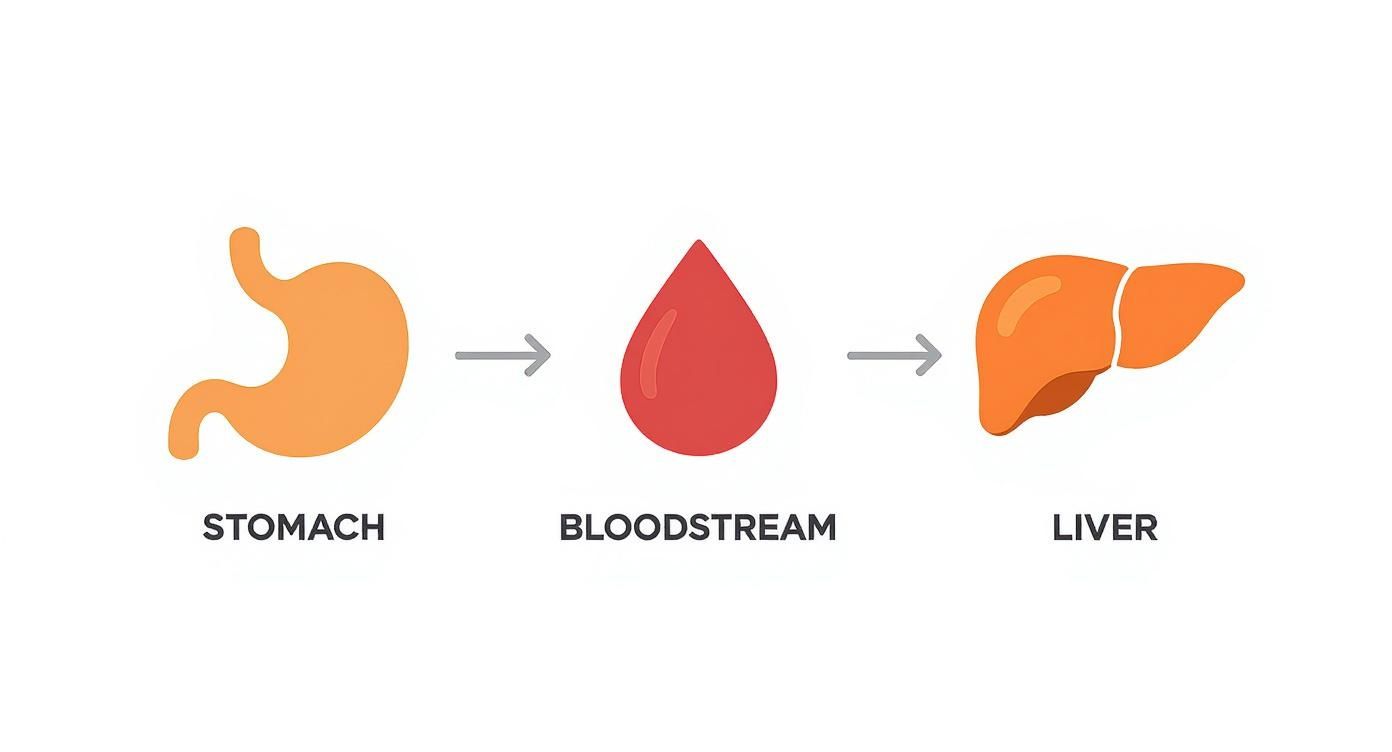
This rapid absorption is what leads to the concept of Blood Alcohol Concentration (BAC). Your BAC is just a measure of how much alcohol is circulating in your blood at any given moment. When you drink faster than your body can process it, your BAC climbs, and you start feeling more intoxicated.
To give you a clearer picture, here's a quick rundown of alcohol's journey from start to finish.
The Stages of Alcohol's Journey Through Your Body
This table gives you a quick summary of the key stages alcohol goes through from consumption to elimination, giving you a clear reference for the entire process.
| Stage | What Happens in Your Body | Key Organs Involved |
|---|---|---|
| Consumption | You take a drink. | Mouth, Esophagus |
| Absorption | Alcohol enters the bloodstream without digestion. About 20% is absorbed through the stomach and 80% through the small intestine. | Stomach, Small Intestine |
| Distribution | The bloodstream carries alcohol to every organ, including the brain, heart, and lungs. | Circulatory System, Brain, Lungs |
| Metabolism | The liver works to break down the alcohol into non-toxic substances. | Liver |
| Elimination | The body removes the last byproducts through urine, breath, and sweat. | Kidneys, Lungs, Skin |
This entire sequence highlights just how involved your whole body becomes in processing a single drink.
Your Liver: The Primary Processing Plant
Think of your liver as the single, overworked bouncer at the door of a very popular club. It’s the main organ in charge of breaking down alcohol and getting it out of your system. But here’s the catch: it can only handle so much at a time.
On average, a healthy liver can metabolize about one standard drink per hour. Anything you drink beyond that rate just keeps circulating in your bloodstream, raising your BAC and affecting your brain and other organs until the liver can finally catch up.
The liver's processing speed is the critical bottleneck in how your body handles alcohol. It has a fixed capacity, and anything beyond that circulates in your bloodstream, affecting your brain, heart, and other tissues until the liver can catch up.
This is why pacing yourself is so important. When you understand this metabolic limit, you can see why chugging drinks is so much harder on your body than sipping one over an hour.
If you want to get into the nitty-gritty of the science, you can learn more about how alcohol is metabolized and understand your body's process in our other guide. This core knowledge really sets the stage for understanding everything from that initial buzz to the next-day hangover.
How Alcohol Changes Your Brain and Behavior
Once that drink hits your bloodstream, it gets a first-class ticket straight to your brain. This is where the real party—and the trouble—starts. That "buzzed" feeling you get? It's not your body speeding up. It’s the exact opposite. Alcohol is a central nervous system depressant, meaning it slows everything down.
Think of your brain as a bustling city with a super complex traffic light system. Alcohol is like a rogue operator who starts messing with the controls, turning the red lights on and dimming the green ones.
The Dimmer Switch Effect on Your Brain
Your brain runs on chemical messengers called neurotransmitters. For our purposes, the two most important players are GABA, the brain's main "brake pedal," and glutamate, its "gas pedal." Alcohol essentially puts a heavy foot on the brake while easing off the gas.
It cranks up the effects of GABA, which is why those first sips usually bring on a wave of relaxation and dialed-down anxiety. At the same time, it pumps the brakes on glutamate, which leads to sluggish thoughts, delayed reactions, and a general slowing of your mental gears.
This one-two punch is the core of what happens when you drink. By boosting the brain's "brakes" (GABA) and hitting pause on its "accelerator" (glutamate), alcohol basically dims the lights on your cognitive functions. The result? Relaxation, lowered inhibitions, and eventually, impairment.
This chemical shift is what’s behind all the classic behavioral changes that come with drinking. The prefrontal cortex, the part of your brain in charge of judgment and keeping you from doing embarrassing things, is one of the first areas to get fuzzy. Suddenly, that questionable dance move or brutally honest comment seems like a fantastic idea.
The Stages of Intoxication as BAC Rises
As you keep drinking, your Blood Alcohol Concentration (BAC) climbs, and these effects get more and more obvious. It’s a predictable progression that can be broken down into stages, each tied to a rising BAC.
-
Euphoria (BAC 0.03-0.12%): This is the "buzzed" stage. You're feeling confident, chatty, and your inhibitions are taking a little vacation. Your judgment is already a bit off, even if you don’t feel it yet.
-
Excitement (BAC 0.09-0.25%): Here's where your coordination starts to go. You might get emotional, your vision could get blurry, and your balance becomes… creative. Suddenly, walking a straight line feels like a complex navigational challenge.
-
Confusion (BAC 0.18-0.30%): At this point, you're pretty disoriented. Memory loss, or "blacking out," can happen as the hippocampus—your brain's memory-maker—gets seriously disrupted. Just standing up is a major accomplishment.
-
Stupor (BAC 0.25-0.40%): This is where you might lose consciousness. Your body's reflexes are severely dulled, and the risk of choking or getting injured skyrockets. This stage is a clear sign of serious alcohol poisoning.
-
Coma and Danger (BAC 0.35% and up): This is a life-threatening medical emergency. Your breathing, heart rate, and body temperature can drop to dangerously low levels, potentially leading to a coma or even death.
Understanding these stages is key. What happens when you drink isn't like flipping a switch; it's a gradual shutdown of critical brain functions. The temporary memory issues you might experience in the confusion stage are a mild form of what many people call brain fog. If you're curious about the mechanics behind that cloudy feeling, our guide explains in more detail what causes brain fog and how it messes with your clarity. This slow decline makes it crystal clear why something like driving becomes so incredibly dangerous long before you reach the later, scarier stages of intoxication.
Unpacking The Science Behind The Morning After Hangover
We've all been there. You wake up after a fun night out, and your body feels like it's staging a full-blown rebellion. That pounding headache, queasy stomach, and soul-crushing fatigue aren't just bad luck—they're the direct result of a complex biological storm that alcohol whips up inside you.
A hangover isn't one single problem. It's your body's way of screaming that it’s been through the wringer, dealing with everything from dehydration and gut irritation to a full-scale immune response. Let's break down what's really going on.
Dehydration: The Thirst You Can't Seem to Quench
One of the first things alcohol does is act as a powerful diuretic. In simple terms, it tells your kidneys to flush out way more water than you're taking in. In fact, for every standard drink, your body can expel up to four times as much liquid.
This massive fluid loss is the main culprit behind classic hangover symptoms like thirst, dizziness, and that relentless headache. Your brain, which is about 73% water, actually shrinks a bit from the lack of fluid. This pulls on the membranes connecting it to your skull, and that's what causes the intense pain. Ouch.
A common myth is that chugging water during a hangover is the ultimate fix. It helps, sure, but the real magic is in proactive hydration. Keeping your fluid and electrolyte levels balanced before, during, and after drinking is a much smarter game plan.
The best defense is a simple one: alternate every alcoholic drink with a big glass of water. It's a small habit that makes a world of difference by counteracting the diuretic effect and keeping your body in a much happier state.
Stomach And Immune System: Under Siege
That sick, unsettled feeling in your stomach? It’s not just in your head. Alcohol directly irritates the lining of your stomach, which ramps up the production of stomach acid. This one-two punch is a major reason for the nausea, vomiting, and general stomach misery that can come with a hangover.
At the same time, your immune system jumps into the fray. Your body sees the byproducts of alcohol metabolism, especially a nasty compound called acetaldehyde, as toxic invaders. This triggers an inflammatory response, releasing chemicals called cytokines.
These are the exact same chemicals your body pumps out when you have the flu. This explains why a bad hangover can feel so similar, bringing on:
- Muscle aches and general soreness
- Overwhelming fatigue and zero energy
- "Brain fog" or difficulty concentrating
- Irritability and wild mood swings
Basically, your body is fighting what it considers a toxic attack, and you're feeling all the collateral damage.
To help you connect the dots between how you feel and what's happening internally, we've put together a quick cheat sheet.
Connecting Hangover Symptoms to Their Biological Causes
This table breaks down common hangover symptoms and links them to their scientific explanations, helping you understand what's really happening in your body.
| Common Symptom | What's Happening in Your Body | Practical Mitigation Tip |
|---|---|---|
| Pounding Headache | Dehydration causes your brain to temporarily shrink, pulling on sensitive membranes. | Alternate alcoholic drinks with water to stay hydrated from the start. |
| Nausea & Stomach Pain | Alcohol irritates the stomach lining and increases acid production. | Eat a balanced meal with fats and protein before drinking to slow alcohol absorption. |
| Fatigue & Weakness | Your immune system releases inflammatory cytokines, and your sleep quality is destroyed. | Focus on quality sleep and consider supplements that support liver function. |
| Dizziness & Thirst | A direct result of fluid and electrolyte loss from alcohol's diuretic effect. | Sip on an electrolyte drink (like coconut water) before bed and upon waking. |
| "Brain Fog" | A combination of dehydration, inflammation, and poor-quality REM sleep. | Give your brain time to recover; avoid complex tasks and stay hydrated. |
Understanding these connections is the first step toward outsmarting your next hangover before it even starts.
Disrupted Sleep: The Illusion of Rest
So many people think a drink before bed is a great sleep aid. While alcohol might make you doze off faster, the quality of that sleep takes a massive hit. Alcohol is notorious for suppressing REM sleep, which is the most restorative phase of your sleep cycle where dreaming and memory consolidation happen.
This disruption means that even if you clock a full eight hours, you're likely to wake up feeling groggy, unrefreshed, and mentally sluggish. It's just one more layer of misery piled on top of the physical symptoms. For a complete scientific breakdown, check out our guide explaining what causes hangovers and how to prevent them.
Actionable Ways To Support Your Body
So, how do you fight back? The smartest strategies are all about supporting your body's natural defense and recovery systems.
- Hydrate Smartly: Don't just chug plain water. Bring in beverages with electrolytes—think coconut water or a sports drink—to replenish the essential minerals you've lost.
- Eat Before You Drink: Never drink on an empty stomach. A meal with healthy fats and protein will slow down alcohol absorption, giving your liver a fighting chance to keep up.
- Replenish Key Nutrients: Alcohol depletes vital nutrients. Ingredients like Dihydromyricetin (DHM), found in the Japanese raisin tree, can help support the liver's ability to process alcohol and its toxic byproducts.
- Choose Your Drinks Wisely: Darker liquors like whiskey and red wine are packed with congeners, compounds known to make hangovers worse. Clear spirits like vodka or gin are generally a safer bet.
By understanding the science, you can shift from just surviving hangovers to actively preventing them. It’s all about giving your body the backup it needs to handle what happens when you drink.
Understanding the Long-Term Effects of Alcohol on Your Health
We all know what a night of drinking feels like the next day. But what about the quiet, cumulative story that unfolds over months or years of regular drinking? A drink here and there is one thing, but consistent, heavy use puts a serious strain on your body's most important systems.
The long-term impact of alcohol isn't as loud as a single bad hangover. It’s a slow burn, affecting major organs in ways you might not feel until the damage is already significant. This isn’t about scaring you; it’s about giving you the full picture so you can make choices that are right for your long-term health.
Your Liver Under Long-Term Stress
Your liver is on the front lines, tasked with breaking down almost every drop of alcohol you consume. Think of it like a heavy-duty filter that’s being forced to work overtime, all the time. This kind of chronic stress can kick off a cascade of serious health problems.
It often starts with alcoholic fatty liver disease, where excess fat gums up the liver cells. This is your body's early warning signal, and thankfully, it's often reversible if you cut back or stop drinking. But if the heavy drinking continues, things can get worse.
The liver is an incredibly tough organ, but it's not invincible. Constant heavy drinking keeps it in a state of chronic inflammation, which can eventually lead to permanent scarring and a major hit to its ability to do its job.
That ongoing inflammation can progress to alcoholic hepatitis, a much more serious condition where the liver is inflamed and its cells start to die off. The final, and most severe, stage is cirrhosis. This is where healthy liver tissue is replaced by scar tissue for good, crippling the organ’s ability to filter toxins, process nutrients, and produce things your body can't live without.
The Heart and Cardiovascular System
Alcohol’s reach extends far beyond the liver, making its way right into your cardiovascular system. You might have heard old studies suggesting a glass of red wine could be good for you, but more recent and thorough research tells a different story when it comes to long-term, heavy use.
Regular heavy drinking is a known contributor to several heart-related issues:
- High Blood Pressure (Hypertension): Alcohol can cause blood vessels to constrict and messes with the nervous system, leading to a sustained spike in blood pressure.
- Irregular Heartbeat (Arrhythmia): Binge drinking, in particular, can throw the heart's electrical signals out of whack, leading to conditions like atrial fibrillation.
- Cardiomyopathy: This is when the heart muscle itself gets weaker, making it a less efficient pump for moving blood through your body.
Over the years, these conditions dramatically increase the risk of serious events like a heart attack or stroke. It’s a silent but serious tax on your heart.
Brain Health and Increased Cancer Risk
The brain doesn't get off easy, either. We're not just talking about the short-term buzz; chronic heavy drinking can cause lasting changes to the brain's actual structure and function. It can literally shrink brain volume, especially in the areas that handle memory and complex thought, and it gets in the way of creating new brain cells.
This can lead to cognitive decline, memory issues, and a higher risk for dementia down the road. It also throws the brain's delicate chemical balance out of sync, which can have a big impact on mood and mental health.
On top of all that, the link between alcohol and cancer is rock-solid. When your body breaks down alcohol, one of the byproducts is acetaldehyde—a toxic chemical that’s a known carcinogen. This nasty compound can damage your DNA and stop your cells from being able to repair themselves.
This damage increases the risk of developing several types of cancers, including:
- Mouth and throat
- Esophagus
- Liver
- Colon and rectum
- Breast
Looking at the big picture, the global statistics are pretty sobering. Alcohol contributes to major conditions like liver cirrhosis and heart disease, and it's responsible for roughly 6% of all deaths worldwide. These far-reaching effects really highlight why it's so important to understand what's happening inside your body. You can dive deeper into the numbers by checking out these alcohol-related statistics and their public health implications.
Why Alcohol Affects People Differently
Ever been out with friends and wondered why one person is giddy after a single drink while another seems totally fine after three? It happens all the time, and it points to a simple truth about alcohol: there's no such thing as a one-size-fits-all response.
How your body reacts is a unique cocktail of genetics, biology, and even what you ate for dinner. Getting a handle on these variables is the key to understanding your own limits and drinking a bit more mindfully. It’s not just about counting drinks; it’s about knowing how your specific body is wired to process them.
Biological and Genetic Factors
Your body's own blueprint plays a huge part in how you handle alcohol. Your genetics, especially, are a major player here, dictating how well your liver produces the enzymes needed to break it all down.
Think of these enzymes—alcohol dehydrogenase (ADH) and aldehyde dehydrogenase (ALDH)—as your body’s personal cleanup crew. Some people are just genetically blessed with a super-efficient crew that processes alcohol quickly. Others have a less effective team, which lets toxic stuff like acetaldehyde hang around longer. This is what leads to those more intense side effects, like the dreaded "Asian flush" and killer hangovers.
Your personal response to alcohol is deeply rooted in your biology. Factors you can't control, like your genetic makeup and biological sex, create a unique baseline for how your body metabolizes every sip you take.
Biological sex also makes a real difference. On average, women have less body water and lower levels of ADH than men. So, if a man and a woman of the same weight have the same number of drinks, the alcohol will likely hit a higher concentration in the woman’s bloodstream, making the effects kick in faster and feel stronger.
Lifestyle and Situational Influences
Beyond your built-in biology, a bunch of choices and situations can change how alcohol hits you on any given day. These are the things you actually have some control over.
One of the biggest? Drinking on a full or empty stomach. Eating a solid meal—especially one with fats, proteins, and fiber—slows down how quickly alcohol gets absorbed into your bloodstream. This gives your liver a head start on processing it, which means a lower peak Blood Alcohol Concentration (BAC). Drinking on an empty stomach, on the other hand, is like hitting the fast-forward button, sending alcohol straight into your system for a much quicker, more intense buzz.
Other key factors include:
- Body Weight and Composition: Generally, a larger person will have a lower BAC than a smaller person after the same amount of alcohol, simply because there's more body tissue to absorb it.
- Age: As we get older, our bodies tend to lose muscle and hold less water, which can lead to a higher BAC. Our livers can also become a bit less efficient over time.
- Tolerance: If you drink regularly, your brain starts to adapt, and you'll need more alcohol to feel the same effects. But here's the catch: this does not mean your liver is getting any faster at its job.
Globally, drinking patterns are all over the map. Around 2.3 billion people worldwide are current drinkers, but how much they drink and the consequences vary wildly by region and culture. In some countries, heavy drinking leads to serious health problems, which just goes to show how both personal and societal factors shape alcohol's impact. You can dive into more of that data on these global alcohol consumption rankings and their health consequences.
Got Questions About Drinking? We've Got Answers.
When it comes to alcohol, there are a lot of questions floating around. How long does it actually stick around in your body? Can you really sober up with a cup of coffee? Let's cut through the noise and tackle some of the most common questions you might have.
Getting straight, practical answers is the key to making smarter choices about drinking.
How Long Does Alcohol Stay in Your System?
This is a big one, and the answer isn't a simple number. How long alcohol can be detected really depends on the type of test being used.
Think of it this way: your body keeps different "records" of your drinking, and each one lasts for a different amount of time.
-
Breath: A breathalyzer can pick up traces of alcohol for up to 24 hours after you stop drinking. It's measuring the alcohol that makes its way from your bloodstream into your lungs.
-
Blood: A blood test gives a very precise snapshot of your current Blood Alcohol Concentration (BAC). Generally, alcohol is detectable in your blood for up to 12 hours, but this can change based on how much you had and how fast your body works.
-
Urine: Urine tests have a longer memory. Depending on the test, alcohol can show up in urine anywhere from 12 to 80 hours after your last drink.
-
Hair: For the long-term picture, a hair follicle test can find traces of alcohol for up to 90 days. This isn't about whether you're intoxicated now; it's a history of your consumption over the last few months.
No matter the test, the most important thing to remember is that your liver processes alcohol at a steady pace—about one standard drink per hour. Nothing can speed that up.
Can You Sober Up Quickly?
We've all heard the tricks: a cold shower, a strong coffee, a greasy slice of pizza. It’s a nice thought, but unfortunately, they’re just myths. While these things might make you feel more awake, they do absolutely nothing to lower your BAC.
Your liver is the only organ that can actually break down alcohol and get it out of your system. A cup of coffee might jolt you awake and fight off the sleepy feeling from alcohol, but it doesn't make you any less impaired. You might be a wide-awake drunk, but you're still drunk.
The only thing that truly sobers you up is time. Your liver needs time to do its job, and there are no shortcuts.
This is a huge safety issue. Feeling more alert can trick you into thinking you're okay to do things like drive, when in reality your judgment and reaction time are still way off.
Is There a Truly Safe Amount of Alcohol to Drink?
This is a tricky one, and the official advice has changed a lot over the years. We used to hear a lot about "moderate drinking" and how it might even be good for your heart. More recent, larger studies have started to tell a different story.
The current scientific consensus, backed by groups like the World Health Organization, is that no amount of alcohol is 100% risk-free. Every drink adds a little bit to your long-term health risks, especially for things like cancer and liver disease.
That doesn't mean you can never have a drink again. It’s more about seeing risk on a spectrum—the less you drink, the lower your risk. Think of official guidelines as harm reduction strategies, not a green light for "safe" drinking.
For instance, the Dietary Guidelines for Americans suggest that if you're going to drink, do it in moderation. For adults, that’s defined as:
- Up to one drink per day for women.
- Up to two drinks per day for men.
Ultimately, you have to weigh the enjoyment you get from a drink against the known health risks. Being informed is the best way to make a choice that feels right for you and your health.
Ready to enjoy your night without worrying about the morning after? Upside has your back. Our Hangover Jelly is packed with natural, science-backed ingredients to help your body process alcohol and bounce back faster. It's vegan, gluten-free, and easy to take on the go. Plan ahead and make your next morning a good one. Visit us at https://enjoyupside.com to learn more and party smarter.
#upside #enjoyupside #upsidejelly #livemore #hangovercure #hangoverprevention #fighthangovers #preventhangovers #HangoverRelief #MorningAfter #PartySmarter #HydrationStation #WellnessVibes #RecoverFaster #NoMoreHangovers #HealthyParty #HangoverHacks #FeelGoodMorning #NightlifeEssentials #HangoverFree #SupplementGoals #PostPartyPrep #GoodVibesOnly #HealthAndParty #HangoverHelper #UpsideToPartying