

· By Annemarie
How to Read Nutrition Facts Labels Like a Pro
Staring at a wall of nutrition labels in the grocery store aisle can feel like trying to crack a secret code. But what if I told you it’s simpler than it looks? It really just boils down to a quick, three-part check: serving size first, then a glance at the calories, and finally, the % Daily Value. That’s it. Nailing this simple process can completely change how you shop.
Your Quick Guide to Smarter Food Choices
If you feel overwhelmed by the numbers and percentages, you're not alone. The Nutrition Facts label is meant to be a helpful tool, but often it just adds to the confusion. The good news? You don’t need to be a nutritionist to get the hang of it. This guide will help you make smarter, faster decisions for your health and feel confident doing it.
Food labeling has been around for a while, starting way back in 1913 with an amendment that required packaged foods to state their quantity. This eventually paved the way for the Nutrition Labeling and Education Act (NLEA) of 1990, which put the modern Nutrition Facts panel on over 95% of packaged foods in the U.S. by 1994.
This visual guide breaks down the first three essential components you should check on any nutrition label.
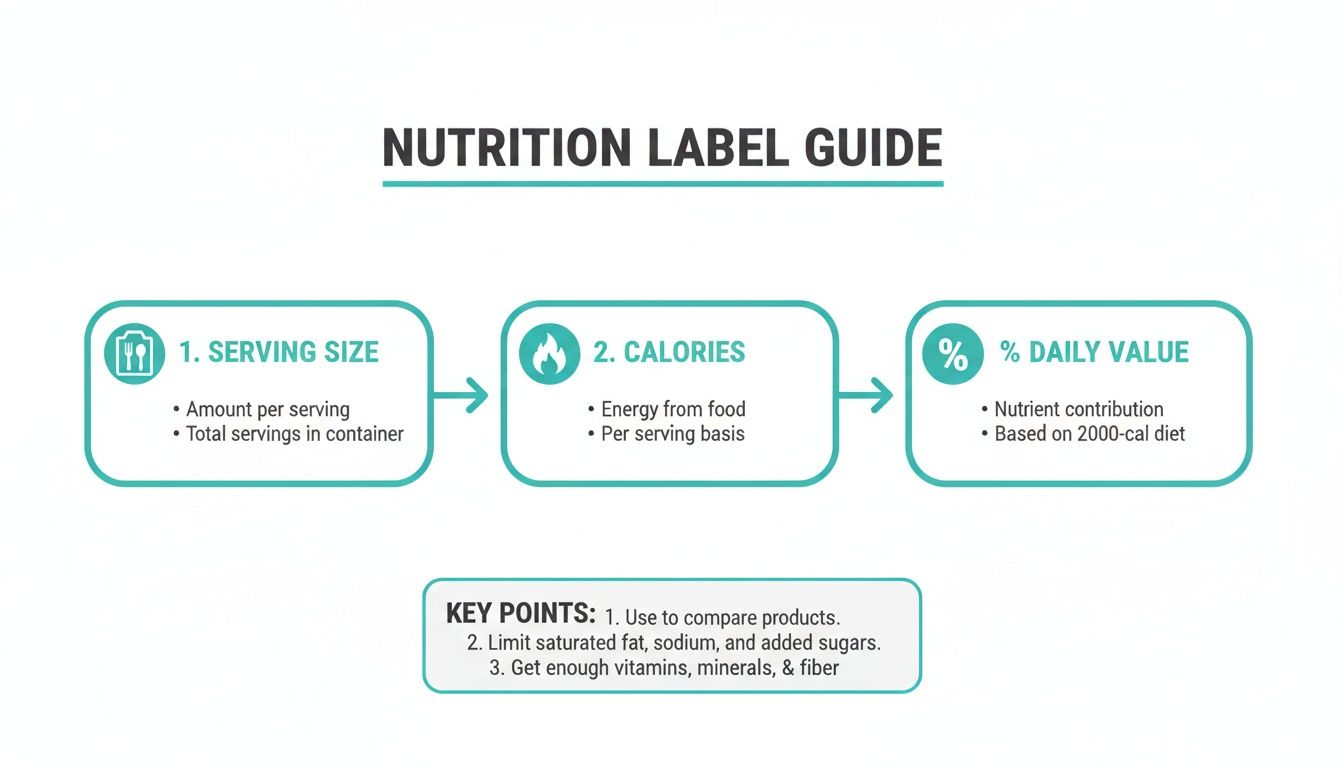
By starting with these three elements—Serving Size, Calories, and the Percent Daily Value—you can quickly get a sense of a food's nutritional profile without getting bogged down in the tiny details.
Let’s take a closer look at the key sections of a nutrition label and what they actually mean for you.
Nutrition Label At a Glance Key Sections
| Label Section | What It Tells You | Quick Tip |
|---|---|---|
| Serving Size | How much of the food is considered one serving. All other numbers on the label are based on this amount. | Always check this first! A small package can often contain 2 or 3 servings. |
| Calories | The amount of energy you get from one serving of the food. | A general guide: 40 calories is low, 100 is moderate, and 400 is high. |
| % Daily Value (%DV) | How much a nutrient in a serving of the food contributes to a total daily 2,000-calorie diet. | 5% DV or less is low. 20% DV or more is high. Use this to find foods high in vitamins and low in things like sodium or added sugar. |
| Nutrients | A breakdown of fat, cholesterol, sodium, carbohydrates, and protein. | Aim for lower %DV on saturated fat, sodium, and added sugars. Aim for higher %DV on fiber, vitamins, and minerals. |
| Ingredients List | All ingredients are listed in descending order by weight. | The first few ingredients make up the bulk of the product. Look for whole foods listed first. |
This table is your go-to reference, but the real skill comes from putting it into practice.
The Foundation of Label Reading
Think of this as your practical cheat sheet for making healthier choices without the stress. We'll start with the most important part of the label—the serving size—because that single detail puts everything else into context. From there, we'll dive into calories and the % Daily Value (%DV) to build a solid foundation.
The goal isn't to become a nutritionist overnight. It's about gaining practical skills to quickly determine if a product aligns with your personal health goals, whether you're managing sodium, cutting back on sugar, or simply aiming for a more balanced diet.
Once you master these basics, you’ll be able to support your well-being with every trip to the store. Making informed choices also helps when you're looking for foods rich in specific nutrients. For example, knowing how to spot key vitamins and minerals can help you find powerful additions to your diet, like those found in this antioxidant-rich foods list. This knowledge empowers you to build a diet that truly fuels your body.
Why Serving Size Is the Most Important Number
Before you even think about calories, fat, or sugar, your eyes need to find one specific spot on that Nutrition Facts label: the serving size. Seriously, this is the foundation for everything else, and it's exactly where most people get tripped up. All those numbers you see for calories, protein, and everything in between? They’re all based on eating just one single serving.
Nailing this down is the first real step to understanding what you’re about to eat. It's so easy to grab a snack that looks like it's for one person, only to find out it contains two, three, or even more servings. That's a classic trap, and it’s how you can accidentally down double or triple the calories, fat, and sugar without a second thought.
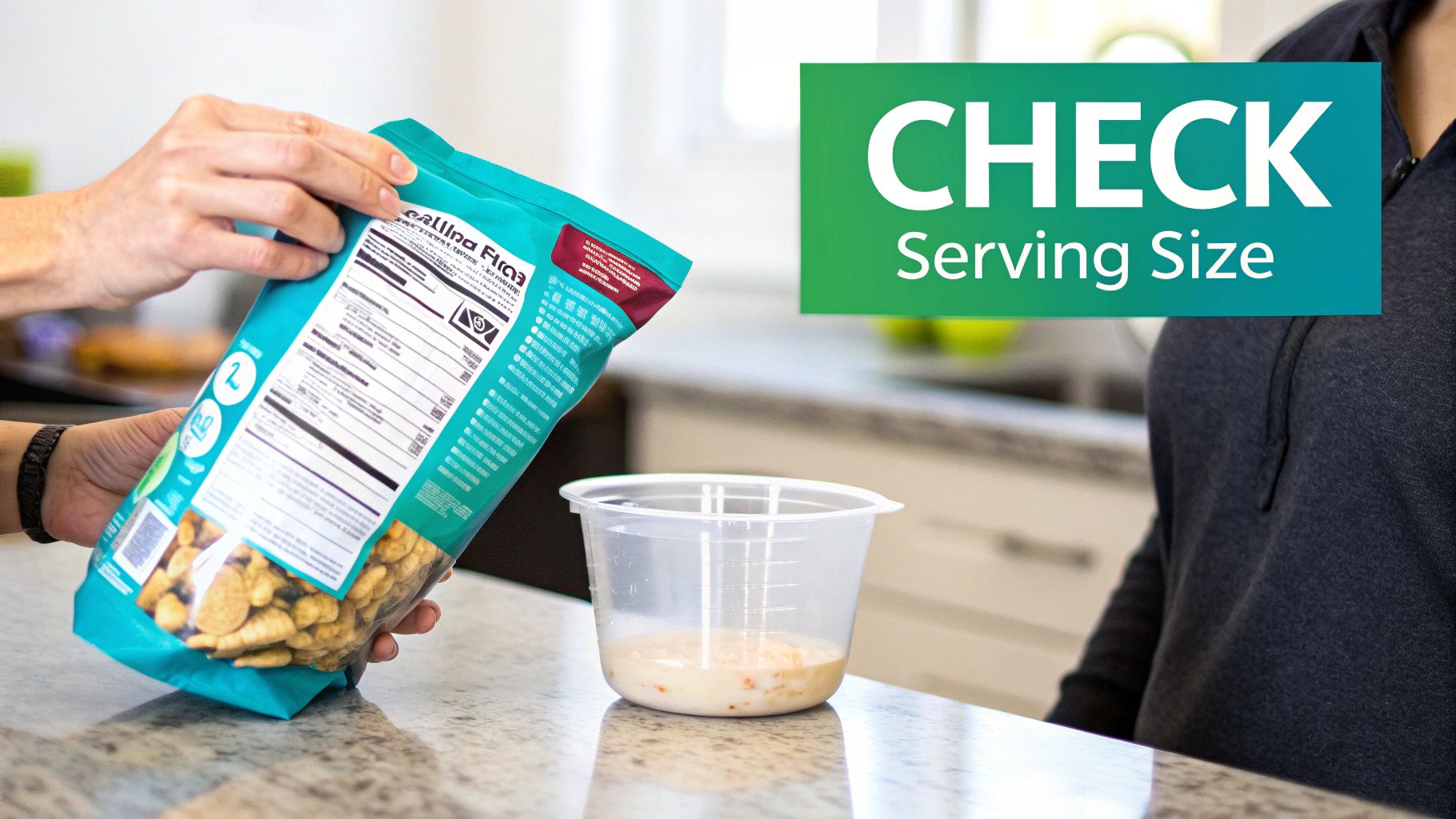
Just think about that big bottle of iced tea you might grab on a hot day. It’s easy to drink the whole thing and assume it's a single portion. But a quick peek at the label might show it actually contains three servings. All of a sudden, that 80-calorie drink is really a 240-calorie commitment.
The Evolution of Realistic Portions
Have you ever felt like serving sizes are more realistic now than they used to be? You’re not imagining things. The game changed with the 1990 Nutrition Labeling and Education Act (NLEA), which first mandated that serving sizes had to reflect how much people actually eat.
But our habits evolved. So in 2016, the standards got another refresh based on national surveys that showed Americans were eating portions up to 20% larger than they were in the 90s. This led to some big moves, like doubling the standard soda serving from 6.5oz to a more true-to-life 12oz.
Before these rules, companies could use random serving sizes that left everyone confused and underestimating their intake by as much as 50%. If you’re interested in the backstory, you can read more on the evolution of food labels on 48hourprint.com. This update was huge—it means less mental math for us in the grocery aisle.
Making Calories Count
Okay, once you’ve got the serving size figured out, your next stop is calories. It's printed in that big, bold font for a reason—it’s a quick snapshot of the energy you’ll get from one serving.
While the general advice is based on a 2,000-calorie daily diet, remember that your own needs can be totally different depending on your age, activity level, and health goals.
Here’s a handy little mental shortcut for judging calories at a glance:
- 40 calories is considered low.
- 100 calories is moderate.
- 400 calories or more is high.
This quick-check system helps you figure out if something fits into your day. If a tiny bag of chips is packing over 400 calories, you know it’s more of a meal than a light snack.
Practical Tips for Portion Control
Knowing the serving size is half the battle; actually sticking to it is the other. This is where portion control comes in, and it's a skill that can keep a quick snack from derailing your nutrition for the entire day.
Your goal isn't to be perfect, but to be mindful. By paying attention to serving sizes, you empower yourself to make conscious choices instead of accidentally over-consuming.
Here are a few actionable tips to help you stay on track:
- Measure It Out: Don't eat straight from the container. Use a measuring cup or food scale to portion out what a single serving actually looks like. You might be surprised.
- Use Visual Cues: Get familiar with what a serving looks like in the real world. For example, a three-ounce serving of meat is about the size of a deck of cards.
- Repackage Bulk Buys: When you buy a giant bag of pretzels or a family-size box of crackers, take a few minutes when you get home to divide it up into single-serving bags.
Mastering the serving size and its link to calories is the most important skill for reading any nutrition label. It’s a simple habit, but it puts you firmly in control of fueling your body right.
Diving Into Fats, Carbs, and Protein
Once you’ve got the serving size figured out, it's time to get into the heart of the label: the macronutrients. This is where you find the big players that fuel your body—fats, carbohydrates, and protein. Looking at these numbers is about more than just counting; it’s about understanding what’s going to give you sustained energy and what might lead to a crash later on.
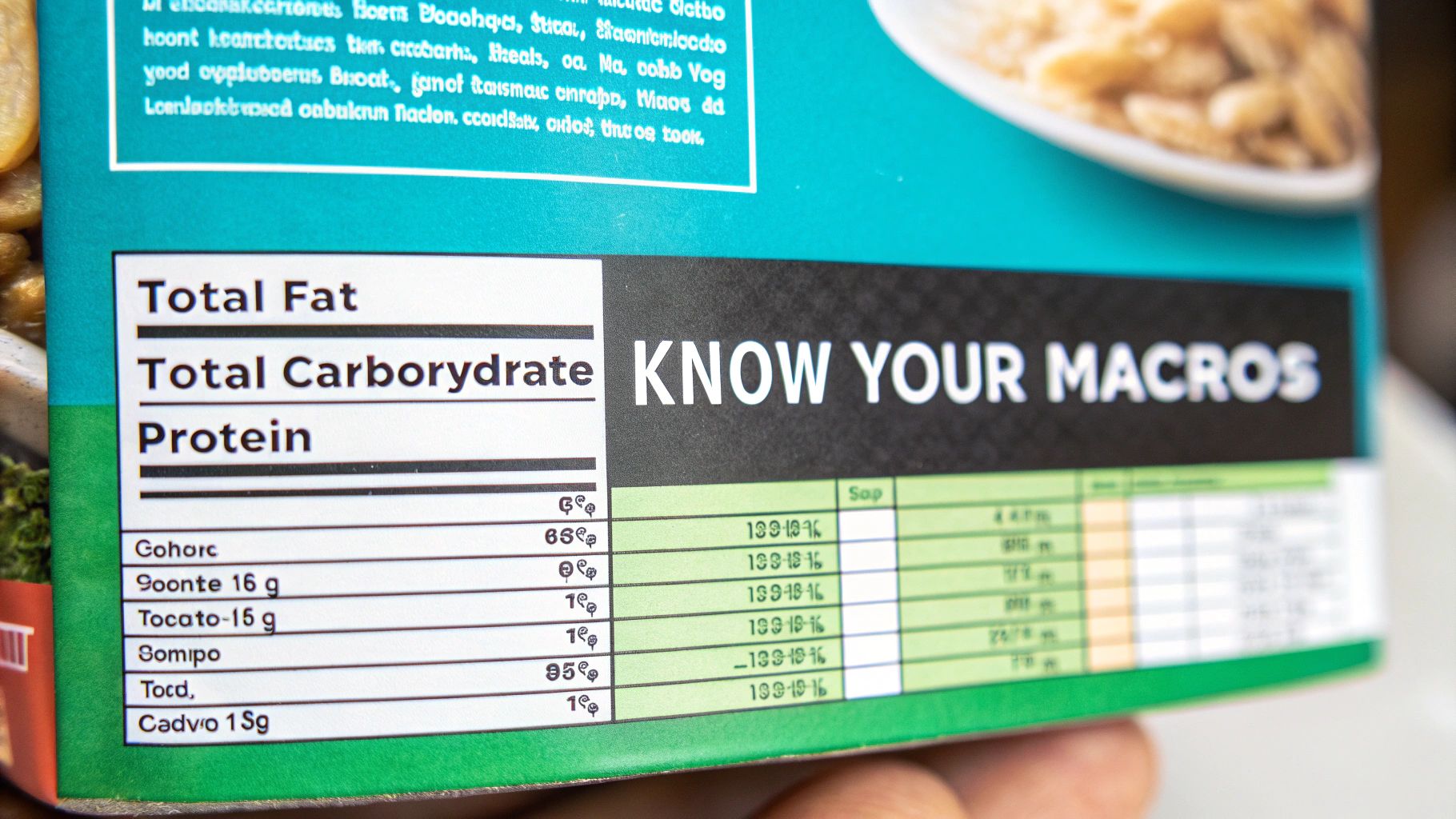
Let's start with fats, which have gotten a bad rap over the years. The "Total Fat" line is really just the headline. The real story is in the indented lines right below it, which break down the types of fat in the product.
Not All Fats Are Created Equal
This is where the label really helps you out. It distinguishes between the fats you want to limit and the ones you should avoid altogether. It’s crucial to look at this breakdown to see what you’re really putting in your body.
You'll see two main types listed here:
- Saturated Fat: This is one you generally want to keep in check. A little bit isn’t the end of the world, but a high intake is linked to some not-so-great health outcomes. A quick rule of thumb is to pick foods where saturated fat makes up a lower percentage of the total fat.
- Trans Fat: This is the one you want to run from. Seriously. Always aim for 0 grams of trans fat. Manufacturers have mostly gotten rid of it due to its health risks, but it can still pop up in some processed foods.
Here's the bottom line: the quality of the fat you eat matters way more than the total amount. Swapping out saturated and trans fats for healthier, unsaturated ones—the kind you find in avocados, nuts, and olive oil—is one of the smartest nutritional moves you can make.
A Quick Look at Sodium and Cholesterol
Next up are sodium and cholesterol. Our bodies need both to function, but most of us get way more than we need, especially from restaurant meals and packaged foods.
When you're scanning the label, let the % Daily Value (%DV) be your guide. If a single serving packs 20% or more of your daily sodium, that’s considered high. Keeping an eye on this is key for staying hydrated and feeling your best—too much salt can leave you feeling sluggish and bloated.
Unpacking Carbs: Fiber and Sugar
Now for carbohydrates, the body’s main source of energy. Just like with fats, the "Total Carbohydrate" number doesn't give you the full picture. The real gems are hidden in the indented lines for Dietary Fiber and Total Sugars.
Dietary Fiber is a true nutritional superstar. It helps with digestion, keeps you feeling full, and can help stabilize blood sugar. When you're comparing things like bread or cereal, the one with more fiber is almost always the better choice.
The Total Sugars line includes sugars that are naturally there (like from fruit or milk) and sugars that were added during processing. This is where things get really interesting, thanks to a fairly new and incredibly helpful addition to the label.
Why the "Added Sugars" Line is a Game-Changer
One of the best updates to the nutrition label in years was making the "Includes Added Sugars" line mandatory. This was a huge win because it finally separates the sugars that are naturally part of a food from the ones a manufacturer threw in.
Why does this matter so much? Because hidden added sugars are everywhere—in sauces, dressings, and even in snacks that look "healthy." Too much of this stuff can cause your energy to spike and then crash hard, which is the last thing you want.
For example, you could have two yogurts with the exact same "Total Sugars." But one gets its sweetness from real fruit, while the other is loaded with corn syrup. The "Added Sugars" line lets you spot the difference in a second. A good benchmark is to just pick products with little to no added sugars whenever you can.
Finally, we have Protein. It's essential for building and repairing just about everything in your body. How much you need depends on your lifestyle and goals, and the label makes it easy to see how much a food is contributing. This helps you pick snacks and meals that will keep you feeling full and support your body.
By getting comfortable with these macronutrient breakdowns, you move from just glancing at numbers to truly understanding the fuel you're choosing.
Using Percent Daily Value for Fast Decisions
Trying to make sense of all the grams and milligrams on a nutrition label can feel like you're back in science class, staring at a test you didn't study for. But there's good news: a built-in shortcut is right there on the label, designed to make your life a whole lot easier. It's the Percent Daily Value (%DV), and it's your secret weapon for making quick, smart decisions in the grocery aisle.
The %DV column gives you the big picture. It shows you how much a nutrient in a single serving contributes to a total daily diet. This simple percentage helps you see if a food is high or low in something without getting lost in the numbers. It's all based on a general 2,000-calorie diet, but it’s a really solid guide for pretty much everyone.
The 5/20 Rule: Your Quick Guide
To really unlock the power of %DV, you just need to remember one simple rule of thumb: the 5/20 rule. Think of it as a mental shortcut that helps you instantly sort the good from the bad.
Here’s the breakdown:
- A %DV of 5% or less means the food is low in that nutrient.
- A %DV of 20% or more means the food is high in that nutrient.
This is a complete game-changer when you're standing in the aisle, trying to pick the healthier option. You can use it to your advantage by aiming for a low %DV for the stuff you want to limit—like saturated fat, sodium, and especially added sugars. On the flip side, you can look for a high %DV for the nutrients you want more of, like dietary fiber, vitamin D, calcium, and potassium.
The 5/20 rule transforms the nutrition label from a list of confusing numbers into an actionable tool. In just a few seconds, you can gauge whether a food supports your health goals.
Putting It Into Practice
Let's say you're in the yogurt aisle, comparing two different brands of vanilla yogurt. You're looking for one that's a great source of calcium but isn't loaded with added sugar. The %DV makes this comparison a breeze.
- Yogurt A: Shows 20% DV for Calcium and 18% DV for Added Sugars.
- Yogurt B: Shows 15% DV for Calcium and 8% DV for Added Sugars.
With the 5/20 rule, you can see right away that Yogurt A is high in calcium (which is great!) but also pretty high in added sugars (not so great). Yogurt B, however, is still a good source of calcium while being much lower in added sugars. With just a quick glance at the percentages, you've made a smarter choice that fits your goals.
To make it even simpler, here's a quick guide on how to use the 5/20 rule for some common nutrients you'll see on the label.
Using the 5/20 Rule for Quick Decisions
| Nutrient | Aim for Low %DV (5% or less) | Aim for High %DV (20% or more) |
|---|---|---|
| Saturated Fat | ✅ Yes, you want to limit this. | ❌ No, avoid high amounts. |
| Sodium | ✅ Yes, keeping this low is ideal. | ❌ No, high sodium can be a concern. |
| Added Sugars | ✅ Yes, the lower, the better. | ❌ No, limit your intake of these. |
| Dietary Fiber | ❌ No, you want more of this. | ✅ Yes, high fiber is a great goal. |
| Calcium | ❌ No, this is a beneficial mineral. | ✅ Yes, look for high sources. |
| Potassium | ❌ No, this is an important electrolyte. | ✅ Yes, high potassium is a good thing. |
By mastering the %DV and the 5/20 rule, you learn how to read nutrition facts labels effectively. It helps you move past just looking at calories and start focusing on the overall quality of the food you're putting in your cart.
Uncovering Insights in the Fine Print
Alright, once you've got a handle on the macros and the %DV, it's time to do some real detective work. The fine print at the bottom of the label is where the most telling details are often hiding. This is where you'll find the vitamins and minerals that actually fuel your body, plus the full ingredient list—a spot where food manufacturers sometimes hide things in plain sight.
This part of the label is where essential micronutrients live. You might see a long list, but the FDA now requires four key players to be listed because they are just that important for our health.
Key Vitamins and Minerals to Watch
Paying attention to these specific micronutrients can make a huge difference in your overall well-being, from bone health to energy levels. They tend to be under-consumed in the typical American diet, which is why they get special placement on the label.
Look for these four required nutrients:
- Vitamin D: Absolutely essential for bone health and keeping your immune system firing on all cylinders.
- Calcium: A powerhouse for building and maintaining strong bones and teeth.
- Iron: This is crucial for carrying oxygen in your blood and preventing that rundown, fatigued feeling.
- Potassium: An important electrolyte that helps maintain fluid balance and supports nerve function. Super important for hydration and recovery.
When you're scanning these, the 5/20 Rule we talked about earlier is your best friend. Aim for products that are high (20% DV or more) in these good-for-you nutrients to make sure you’re getting enough of the good stuff.
Cracking the Code of the Ingredient List
Just below the main nutrition panel, you'll find the ingredient list. Honestly, this might be the most revealing part of the whole package.
The single most important rule here is that ingredients are listed in descending order by weight. This means the first one or two ingredients make up the bulk of what you're actually eating.
If sugar—in any of its sneaky forms—is one of the first few ingredients, you can bet the product is loaded with it, no matter what the pretty packaging claims. This simple check gives you a powerful look into the food's true nature.
This is where you can become a true food detective, spotting things that the numbers up top don't always fully reveal. For instance, it's where you'll find hidden sugars disguised under dozens of different names.
Spotting Hidden Sugars and Allergens
Sugar has a ton of aliases. Learning to recognize them is a superpower when you're trying to make healthier choices. Keep an eye out for terms like:
- High-fructose corn syrup
- Dextrose, maltose, or sucrose
- Cane juice or evaporated cane juice
- Barley malt syrup
The 2016 FDA label update made spotting these a lot easier by requiring the "Includes Xg Added Sugars" line. This change was a direct response to data showing Americans consumed about 17 teaspoons of added sugar daily back in 2010. After the new labels rolled out, U.S. added sugar intake dropped by 10%—proof that clear information helps people make better choices.
This section is also where you'll find critical allergen information. Manufacturers have to clearly state if a product contains any of the top major allergens. This is often in bold within the ingredient list or in a separate "Contains" statement right below it, making it easy to spot if you have sensitivities.
This same principle of carefully checking ingredients applies to more than just food. If you're curious about what goes into your other wellness products, you can check out our guide on how to read supplement labels to apply these skills more broadly.
Got Questions About Nutrition Labels? We’ve Got Answers.
Even once you get the hang of the basics, some real-world products can still leave you scratching your head in the grocery aisle. The Nutrition Facts label is loaded with info, but specific questions always seem to pop up that aren't immediately obvious.
Let's walk through some of the most common ones. Getting a handle on these nuances is the final step in learning how to read nutrition facts labels like someone who’s been doing it for years. It’s all about putting the knowledge into practice so you're never caught off guard.
Why Do Some Packages Have Two Columns?
Ever grab a 20-ounce soda or a pint of ice cream and spot two columns of nutrition info? That’s the "dual-column" label, and honestly, it’s one of the most useful updates the FDA has made. It's designed specifically for packages that have more than one serving but could realistically be eaten in one sitting. We've all been there.
The first column, "Per Serving," gives you the numbers for a single, standard serving size. The second column, "Per Container," lays out the grand total if you go for the whole package.
This simple change means you don't have to do any frantic mental math. It’s total transparency, so you know exactly what you’re getting into—from calories to sugar—if you decide to finish the whole thing.
Think of the dual-column label as a great tool for mindful eating. It’s not there to judge you for eating the whole package, but it makes sure you’re making an informed choice about the full nutritional hit.
What's the Difference Between Total Sugars and Added Sugars?
This is a big one. Understanding this distinction can completely change how you see a product.
On the label, "Total Sugars" includes every single gram of sugar in the food. This counts both the sugars that are naturally there (like fructose in fruit or lactose in milk) and any that were thrown in during processing.
Natural sugars come packaged with other good stuff like fiber, vitamins, and minerals.
But the line item "Includes Added Sugars" is what you really want to watch. This number isolates only the sugars and syrups that were added to the food—think table sugar, high-fructose corn syrup, honey, or maple syrup. Health experts are clear that we should limit these because they just add calories without any real nutritional upside. Having this called out separately is a game-changer for spotting products you might want to reconsider.
Can the Label Help Me Pick Better Drink Mixers?
Absolutely. The nutrition label is your secret weapon for balancing a social life with your health goals, especially when it comes to mixers. Before you head out, a quick comparison of labels on juices, sodas, or tonic waters can make a massive difference in how you feel the next day.
Use the label to hunt down options with low "Added Sugars" and "Sodium," which can help you stay hydrated and dodge that nasty sugar crash. The %DV is your best friend here.
A few practical tips:
- Scan for Added Sugars: Look for mixers with 0g of added sugars. Seltzers, club soda, or diet tonic water are usually your safest bets.
- Check the Sodium: Aim for options with less than 5% DV for sodium. Salty mixers will only make dehydration worse.
- Read the Ingredients: Go for mixers with short, simple ingredient lists. If sugar or corn syrup is one of the first few ingredients, put it back.
How Do Vitamins on the Label Support Recovery?
Don’t just skim past the vitamins and minerals listed at the bottom of the label—they’re crucial for how your body functions and recovers. Potassium, for example, is a key electrolyte that helps manage your fluid balance, which is essential for hydration. Iron is vital for carrying oxygen in your blood, helping you fight off that tired, run-down feeling.
Certain B vitamins are also super important for energy metabolism. While they aren't always required on the main label, knowing what they do is key. For a deeper look into how these work, you can explore the benefits of Vitamin B-complex in our detailed guide.
By using the label to find foods rich in these micronutrients, you can make smarter choices that actually help you feel your best.
At Upside, we believe in living life to the fullest without sacrificing your well-being. Our Hangover Jelly is designed to support your body's recovery with a blend of natural, effective ingredients, so you can enjoy your night and still feel great the next day. Make smarter choices, party smarter, and wake up refreshed.
Discover how Upside can fit into your balanced lifestyle at https://enjoyupside.com.
#upside #enjoyupside #upsidejelly #livemore #hangovercure #hangoverprevention #fighthangovers #preventhangovers #HangoverRelief #MorningAfter #PartySmarter #HydrationStation #WellnessVibes #RecoverFaster #NoMoreHangovers #HealthyParty #HangoverHacks #FeelGoodMorning #NightlifeEssentials #HangoverFree #SupplementGoals #PostPartyPrep #GoodVibesOnly #HealthAndParty #HangoverHelper #UpsideToPartying