

· By Annemarie
Charcoal capsules hangover: Do They Really Work?
The promise sounds almost too good to be true: pop a few charcoal capsules for a hangover after a night out and wake up feeling brand new. It's the kind of viral hack that fills your social media feed, suggesting you can completely sidestep the next morning’s regrets with one simple trick. But is there any truth to this trend, or is it just another wellness myth?
The Viral Promise of a Perfect Hangover Cure
We’ve all seen it while scrolling—a picture-perfect solution for the morning after. The trend of using activated charcoal for hangovers has absolutely exploded, mostly thanks to personal stories and convincing before-and-after posts. It paints a very appealing picture: you can enjoy your night to the absolute fullest without paying for it the next day.
This whole idea taps into that universal desire for a quick fix. I mean, who wouldn't want a magic button to erase the headache, nausea, and general misery of a hangover? The trend gains traction because it feels plausible. Activated charcoal is legitimately used in emergency rooms as a detoxifying agent, which gives the hangover claim a veneer of medical authority.
Why This Trend Has Such a Strong Hold
The popularity here isn't just wishful thinking. It's fueled by powerful, relatable anecdotes. Someone shares their personal "experiment," often with rave reviews, and convinces their friends to try it, who then convince their friends. It creates a feedback loop of hype where personal experience starts to feel more real than scientific evidence.
The core reasons this went viral are pretty simple:
- It's easy: The instructions couldn't be more straightforward—just swallow a few capsules.
- It's available: Activated charcoal is cheap and you can find it at any drugstore or online.
- It sounds official: Its real medical use for poisoning makes the hangover claim seem a lot more credible than it is.
This guide is here to cut through all that noise. We're going to dig into why this remedy got so popular, look at the stories fueling the trend, and then stack them up against what science actually says.
Our goal is to give you a clear, honest answer. We’ll break down the biology, the evidence for and against it, and ultimately help you figure out if using charcoal capsules for a hangover is a smart move for your morning after.
How Activated Charcoal Really Works
To figure out whether charcoal capsules can actually help a hangover, we first need to get one thing straight: this isn't the same stuff you find in your backyard grill.
The activated charcoal used for wellness is a specialized, medical-grade material. It's processed at incredibly high temperatures, which creates millions of tiny, microscopic pores. This process gives it an enormous amount of surface area, turning each particle into something like a magnet for certain molecules.
The Science of Adsorption, Not Absorption
Here's where most people get tripped up. The key mechanism at play here is adsorption—with a "D," not a "B." It's a totally different concept from absorption.
A kitchen sponge absorbs water, soaking it up into its internal structure. Activated charcoal, on the other hand, works through adsorption, which means chemicals and toxins physically stick to its external surface. Think of it less like a sponge and more like a massive surface covered in molecular-level Velcro.
To make this distinction crystal clear, here’s a quick breakdown of how these two processes differ.
Adsorption vs Absorption at a Glance
| Concept | Mechanism | Real-World Analogy |
|---|---|---|
| Adsorption | Molecules stick to the surface of a substance. | A piece of tape picking up dust from a table. |
| Absorption | Molecules are drawn inside of a substance. | A paper towel soaking up a spill. |
As you can see, charcoal doesn't soak anything up. It simply provides countless binding sites on its vast, porous surface where certain compounds can get trapped. This is exactly why emergency rooms have used it for decades to treat specific types of drug overdoses and poisonings—it latches onto harmful substances in the stomach before the body can absorb them into the bloodstream.
This infographic really gets to the heart of the matter, showing the massive gap between social media hype and what the science actually says.
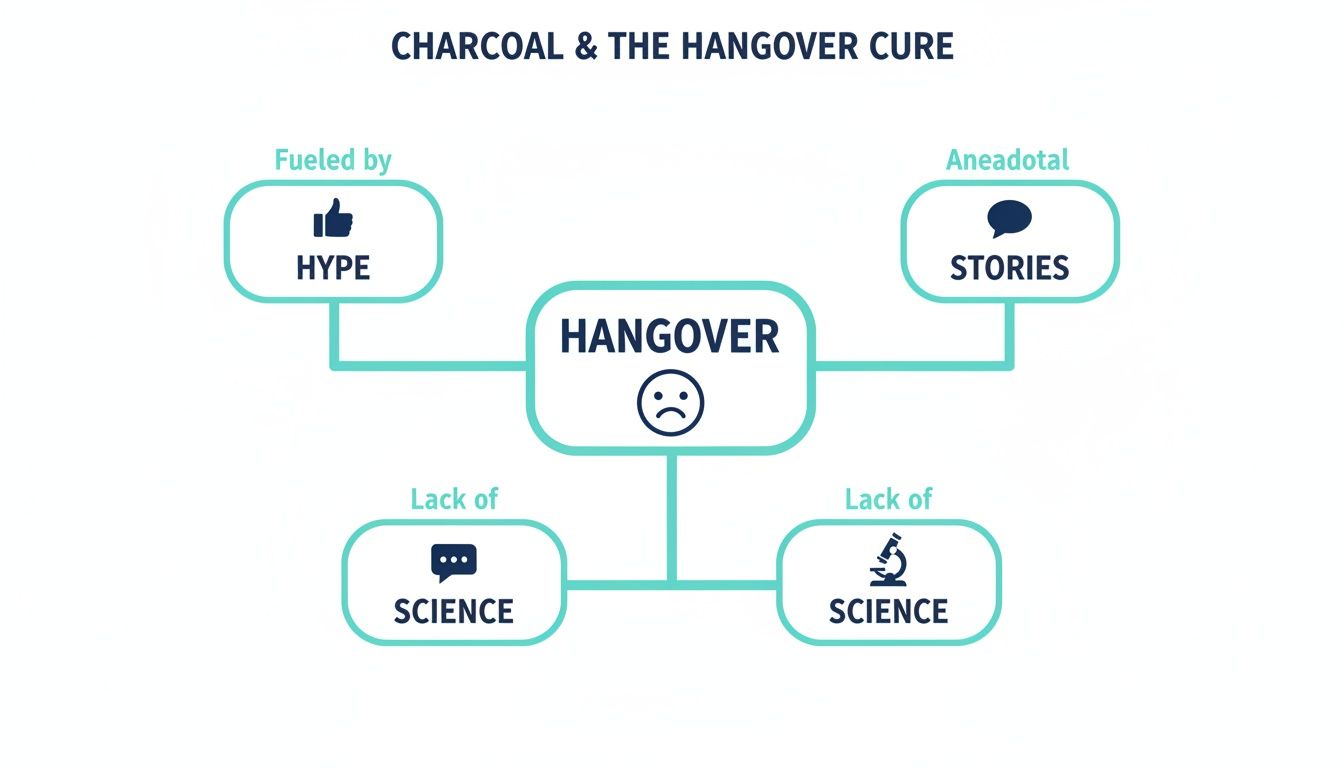
It’s easy to see how the idea got started. People hear "toxin removal" and immediately connect it to a hangover. But just because it works for some things in a hospital setting doesn't automatically mean it works for a night of drinking.
Why This Matters for Hangovers
The entire theory behind using charcoal capsules for a hangover relies on the idea that charcoal can bind to alcohol—or its toxic byproducts—the same way it binds to other substances. The hope is that it could trap these compounds in your digestive tract, preventing them from ever reaching your system and causing all that next-day misery.
But here’s the catch: the effectiveness of adsorption depends entirely on what the charcoal is trying to bind to. Some molecules stick to it like glue, while others barely stick at all.
This is where the hangover cure theory starts to fall apart. For a deeper dive, you can learn more about activated charcoal for alcohol in our complete guide, but the short version is that alcohol just isn't one of the things it binds to very well.
What About All the Personal Stories?
Science aside, if you spend any time online looking for hangover cures, you'll find countless stories from people who absolutely swear by activated charcoal. Let's be honest, this is probably why you're here in the first place.
Online forums and social media are packed with convincing personal accounts. These stories are powerful because they're relatable. When a friend—or even just a compelling stranger on the internet—tells you, "I tried this, and it worked," it often hits harder than a dry scientific paper. That simple narrative is the real engine behind this trend.
The Power of N=1 Experiments
Many people who use charcoal for hangovers see it as their own personal "biohack." They're running an experiment with a sample size of one: themselves. And sometimes, the results they report are pretty dramatic.
One of the most famous examples comes from a tech enthusiast who tracked his own drinking data for two years. On 26 different occasions, he took two 520mg capsules of activated charcoal before bed after a night of heavy drinking.
The results? He claimed a staggering 92% reduction in headaches and a 90% drop in nausea compared to what he’d normally expect. It’s hard to argue with numbers like that, even if they aren't from a formal study. You can check out his full breakdown and see why personal deep-dives like this are so convincing.
While it’s not a controlled clinical trial, an experiment on yourself feels real. It’s this kind of personal, results-driven evidence that convinces most people to give something a try.
So, Why Are These Stories So Persuasive?
Why do we put so much stock in these anecdotes, especially when the scientific evidence is shaky? It really comes down to a few basic psychological triggers:
- We can relate. Everyone knows the misery of a bad hangover, so a story about finding a fix feels personal and relevant.
- It’s simple. The idea is easy to grasp: take a pill, feel better. No need to decipher complex biological pathways.
- The Placebo Effect is real. If you truly believe something is going to work, you can often feel a real improvement in your symptoms. Your brain is a powerful thing.
These success stories, especially the detailed ones, have built the entire foundation for the charcoal-for-hangovers trend. They provide the "social proof" that keeps the conversation going. But it also begs the question: does the actual science back up what these individuals are feeling?
What the Science Says About Charcoal and Hangovers
While personal stories can be compelling, they don't always line up with biological reality. When we put the anecdotes aside and look at the actual clinical data, the whole theory of using charcoal capsules for a hangover starts to fall apart pretty quickly.
The entire idea hinges on one big, flawed assumption: that activated charcoal can grab onto alcohol molecules and flush them out of your system.
Science, however, tells a totally different story. The molecule that gets you drunk is ethanol, and it’s tiny and simple. Activated charcoal is great at trapping big, complex toxins on its super-porous surface, but ethanol is another beast entirely. It’s like trying to catch sand with a net made for baseballs—the target is just too small and slips right through.
This isn’t just a hypothesis; it’s well-documented. Because charcoal has such a poor grip on ethanol, taking it does next to nothing to stop your body from absorbing the alcohol you've consumed.
The Problem of Rapid Absorption
Let's imagine for a second that charcoal was better at binding to ethanol. There's still another huge problem it can't solve: timing.
Alcohol gets into your bloodstream incredibly fast. A good amount of it is already in your system just minutes after your first sip. Your stomach and small intestine are quick to pass it along, which is why you feel the effects so quickly.
By the time you remember to take charcoal capsules—usually hours later when you're getting ready for bed—most of the alcohol is long gone from your digestive tract. It's already cruising through your bloodstream and being processed by your liver.
Taking activated charcoal for a hangover is like trying to clean up a spill long after it has already soaked deep into the carpet. The window of opportunity to trap it in the stomach is incredibly brief, and for the most part, it closes before you even finish your night out.
This timing issue is the critical flaw in the whole argument. Charcoal can only act on what's physically in the stomach, and with alcohol, that moment is over in a flash.
What Clinical Trials Reveal
So, what happens when this theory is actually put to the test in a controlled lab? The results are definitive and pretty blunt: activated charcoal just doesn't work for alcohol consumption.
Pharmacokinetics studies, which track how stuff moves through our bodies, have put this idea to rest. In one key clinical trial, people were given a hefty 60-gram dose of super-activated charcoal after drinking ethanol. The study found it didn't reduce total alcohol absorption at all.
In fact, the peak ethanol levels were actually 8% higher in the group that took the charcoal. If you want to dive deeper into why this method is a bust, you can explore more findings on the charcoal and hangover connection.
The scientific verdict is in. Leading health resources all agree there’s simply no proof that charcoal binds effectively to ethanol, the very molecule that causes intoxication and contributes to that morning-after misery. It's a medical tool with a specific, life-saving job, but that job has nothing to do with fixing the consequences of a fun night out.
The Hidden Risks of Using Charcoal Capsules
So, we've established it doesn't really work for hangovers. But beyond just being ineffective, popping activated charcoal capsules comes with some very real risks you need to know about. Its greatest strength in the ER—that powerful binding ability—is actually its biggest liability for casual use.
The heart of the problem is that activated charcoal is completely non-selective. Think back to that porous, Velcro-like surface. It doesn't have a "blacklist" for bad stuff; it just latches onto almost everything it bumps into on its way through your digestive system.
This means it can grab onto the vitamins and minerals from that healthy meal you just ate, stopping your body from ever getting the good stuff. Doing it once probably won't hurt, but if it becomes a habit, you could start messing with your nutritional balance.
The Dangers of Medication Interference
This is where things get serious. The biggest risk of taking charcoal capsules for a hangover is how it can interfere with medications. Because it can’t tell the difference between molecules, it will happily bind to your prescription drugs, trapping them and flushing them out before they can do their job.
For anyone who relies on time-sensitive medication, this can be a huge problem. A consistent dose is often critical, and charcoal throws a major wrench in that.
- Birth Control Pills: Activated charcoal can adsorb the active hormones in oral contraceptives, which could make them less effective and raise the risk of an unplanned pregnancy.
- Antidepressants and Anti-Anxiety Meds: These medications often need to maintain stable levels in your bloodstream to work properly. Charcoal can disrupt that delicate balance.
- Heart and Blood Pressure Medication: For people managing cardiovascular conditions, any unexpected drop in dosage can be genuinely dangerous.
- Thyroid Medication: It can also get in the way of your body absorbing thyroid hormones, which can mess with your metabolism.
The bottom line is this: if you take any kind of regular medication, introducing activated charcoal without talking to your doctor is a massive gamble. Its non-selective nature can accidentally cancel out the very medicines you need to stay healthy.
Other Unpleasant Side Effects
Even if you’re not on any medication, there are still a few other downsides to think about. Activated charcoal is notorious for causing some pretty uncomfortable digestive issues. The most common one by far is constipation, as the charcoal basically gums up the works in your gut.
You might also notice black stools, and in rare instances, it can cause more serious problems like intestinal blockages. Considering that using charcoal capsules for a hangover is a bust scientifically, these added risks make it an even worse bet.
If you want to dig a little deeper, our guide on activated charcoal and alcohol breaks down these concerns in more detail.
Smarter Ways to Prevent a Hangover
Alright, so we've established that charcoal capsules for a hangover are pretty much a scientific dead-end. It's time to shift our focus to strategies that actually get the job done. A real hangover solution needs to tackle the root causes head-on: serious dehydration, your immune system's inflammatory freak-out, and the loss of key nutrients.
Instead of chasing myths, the smarter move is to support your body’s own recovery systems. The goal isn't to magically erase the alcohol you drank, but to give your body the tools it needs to process it all and bounce back faster. That means focusing on hydration, replenishing electrolytes, and giving your liver some targeted support.
A Modern, Science-Backed Approach
Thankfully, modern solutions have moved way past the simplistic (and risky) charcoal trend. Today, you can find hangover prevention aids that are specifically formulated to address the complex biological toll that drinking takes on your body. These products deliver targeted, natural ingredients designed to support your recovery from the moment you start sipping.
This is a huge step up from old, ineffective remedies. The idea of using charcoal for "intoxication" goes all the way back to ancient Egypt and was even pushed by 19th-century pharmacists. But as we've covered, modern science shows it’s basically useless for hangovers because it just doesn't bind well to ethanol. This long history of hope vs. reality really drives home the need for solutions that are actually foolproof.
The best hangover prevention strategy is proactive, not reactive. It’s about working with your body’s biology to minimize the damage before it happens, instead of just trying to clean up the mess afterward.
Convenient options, like portable, soy-free jellies, offer a practical alternative that actually works. They use proven, natural ingredients to hit the real sources of hangover symptoms—a world away from charcoal's impracticality and total lack of scientific backing.
Key Pillars of Hangover Prevention
For a plan that genuinely works, you need to focus on these three core areas. They address what your body actually loses and needs during and after a night out.
- Hydration and Electrolyte Balance: Alcohol is a diuretic, which is just a fancy way of saying it makes you pee a lot. This causes you to lose fluids and essential minerals like potassium and sodium. Topping these back up is crucial for dodging those killer headaches and that next-day fatigue.
- Liver Support: Your liver works overtime to process every drop of alcohol. Ingredients like milk thistle and NAC (N-acetyl-cysteine) can help support its natural detoxification functions and give it a helping hand.
- Nutrient Replenishment: Drinking can burn through your body's supply of vital nutrients, especially B vitamins, which are critical for producing energy. Restoring these levels is key to fighting off that sluggish, drained feeling the next day.
By adopting a smarter, more reliable strategy, you can enjoy your social life without writing off the next day. For a deeper dive into effective strategies, check out our guide on how to prevent a hangover.
A Few Last Questions
Alright, let's wrap this up. If you've still got a couple of questions rattling around, you're not alone. Here are the quick-and-dirty answers to the most common things people ask about hangovers.
Can Supplements Actually Cure a Hangover?
Let's be real: there’s no magic pill that will instantly erase a hangover once you’re in the thick of it. That ship has sailed.
However, certain supplements are incredibly good at preventing one from ever docking. When you take them before you drink or right after your last call, you’re giving your body the raw materials it needs to process alcohol and fight back against its nasty side effects, like dehydration and nutrient drain.
So, Is It Better to Take Hangover Supplements Before or After Drinking?
For the best results, you've got to be proactive. Taking supplements before you start drinking—or at the very least, before you go to bed—is the winning strategy.
This approach gives your liver a helping hand and starts replenishing nutrients while the alcohol is still being broken down. It's way more effective than playing damage control the next morning when you're already feeling the pain.
What’s the Best Thing to Take for a Hangover, Then?
First off, forget the charcoal capsules hangover myth. It just doesn't work that way.
The best hangover remedies are the ones that tackle the problem from three different angles:
- Hydration: Getting your fluids and electrolytes (think potassium and sodium) back in balance is non-negotiable.
- Liver Support: You need ingredients like milk thistle or NAC to help your liver do its heavy lifting.
- Nutrient Replenishment: Alcohol torches your B vitamins, so restoring them is key to shaking off that classic hangover fatigue and brain fog.
Look for a solution that hits all three of these points. That's how you know it’s the real deal.
A smart hangover strategy isn’t about chasing a miracle cure; it’s about giving your body targeted support before the worst symptoms ever have a chance to show up. That proactive mindset makes all the difference.
Ready to party smarter and actually enjoy your morning? Ditch the myths and try a science-backed solution that works. Upside Hangover Jelly is your pocket-sized secret weapon for a better day after. Grab yours today and feel the difference!
#upside #enjoyupside #upsidejelly #livemore #hangovercure #hangoverprevention #fighthangovers #preventhangovers #HangoverRelief #MorningAfter #PartySmarter #HydrationStation #WellnessVibes #RecoverFaster #NoMoreHangovers #HealthyParty #HangoverHacks #FeelGoodMorning #NightlifeEssentials #HangoverFree #SupplementGoals #PostPartyPrep #GoodVibesOnly #HealthAndParty #HangoverHelper #UpsideToPartying