

· By Annemarie
Effective Strategies for Acetaldehyde Reduction in 2026
You wake up with a dry mouth, a dull headache, a stomach that feels vaguely offended, and that familiar promise to yourself that next time you'll “be smarter about it.” Common advice includes drinking water, eating carbs, and sleeping it off. None of that is wrong. It's just incomplete.
A lot of that morning-after misery has a biochemical name: acetaldehyde. It's the short-lived but nasty compound your body makes while breaking down alcohol. If ethanol is the drink you chose, acetaldehyde is the mess your metabolism has to clean up before you can feel normal again.
That's why acetaldehyde reduction matters. Not because it's a trendy phrase, but because it gives you a better way to think about prevention. Instead of asking, “What's the best hangover cure?” a more useful question is, “Where in the process is the problem, and what kind of strategy fits that step?”
That framing changes everything. Some approaches try to slow the buildup. Some try to help clear it faster. Others focus less on the acetaldehyde itself and more on the oxidative stress and tissue irritation it leaves behind.
That Morning-After Feeling Has a Name
The classic hangover feels chaotic, but the chemistry isn't random. You had drinks. Your body got to work. Somewhere in that process, a toxic intermediate built up faster than your system could clear it. That intermediate is acetaldehyde, and it's a major reason the next morning can feel rough.
A lot of readers get tripped up here because they assume alcohol itself is the whole story. Ethanol absolutely matters. But the body doesn't just let ethanol sit around. It converts it. In the middle of that conversion, acetaldehyde appears, and that's where many symptoms begin to make more sense.
Consider cooking on a stovetop: The pan isn't the problem. The smoke is. If the kitchen vents can't keep up, the room gets unpleasant fast. In the same way, alcohol metabolism creates a toxic byproduct, and if your body's “ventilation system” can't clear it efficiently, you feel the consequences.
Plain-English takeaway: A hangover isn't just “too much alcohol.” It's often “too much acetaldehyde, too fast, for your body to handle comfortably.”
That idea also helps explain why generic advice can feel hit-or-miss. Water helps some symptoms. Food can change the speed of absorption. Sleep helps recovery. But none of those directly answers the core biochemical question of how quickly acetaldehyde is being produced, cleared, or neutralized.
Once you see the problem that way, hangover prevention becomes less mystical. It turns into a practical exercise in timing and mechanism.
How Your Body Handles Alcohol Metabolism
Your body processes alcohol in a sequence, not all at once. The first step is handled mainly by an enzyme called alcohol dehydrogenase, or ADH. ADH converts ethanol into acetaldehyde. Then another enzyme family, aldehyde dehydrogenase, or ALDH, converts acetaldehyde into acetate, which is much less problematic.
That sounds tidy on paper. In real life, it can bottleneck.
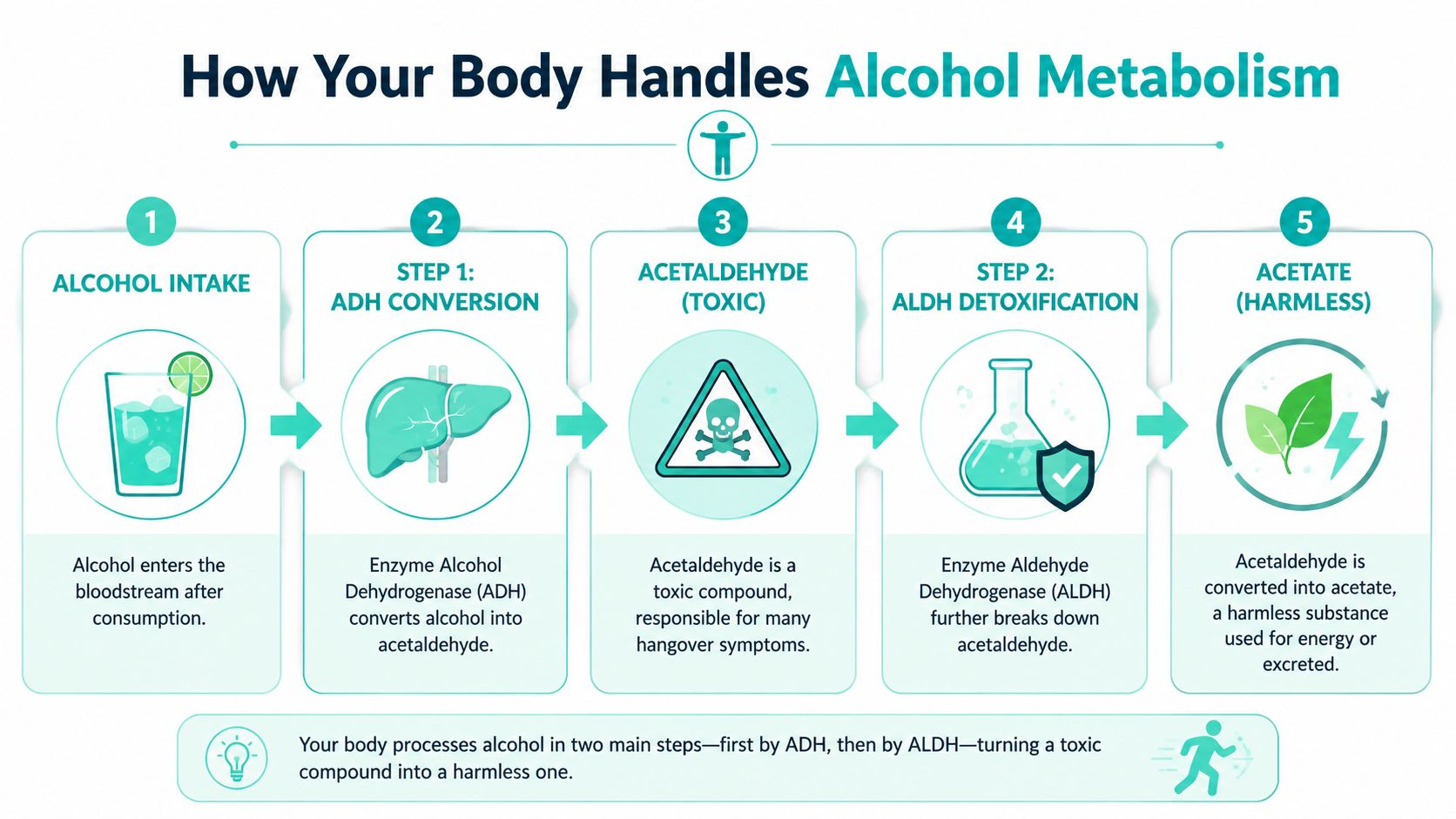
The two-step assembly line
The easiest way to picture this is as a factory line.
-
Step one moves fast
ADH takes the alcohol you drank and starts converting it. -
Step two has to clean up the dangerous intermediate
ALDH takes acetaldehyde and turns it into acetate. -
Trouble starts when step one outruns step two
If acetaldehyde is being made faster than it can be cleared, it piles up.
That pileup is the biochemical version of traffic backing up at a tunnel entrance. Cars keep arriving, but the exit lane can't move them through fast enough.
A related way to think about it is smoke from a fire. The body started with one fuel source, alcohol. While burning through it, it generated a toxic cloud. Discomfort comes when that cloud lingers.
Why the pileup happens
ALDH, especially ALDH2 in the liver, has a high affinity for acetaldehyde, but it can still become overwhelmed. In humans, ALDH2 has a low Km for acetaldehyde of about 1 to 2 μM, and during heavy drinking acetaldehyde can rise from under 2 μM to over 100 μM, with symptoms such as flushing, nausea, and headache linked to that surge, according to this PubMed summary of acetaldehyde metabolism.
That number matters because it clears up a common confusion. People often hear “your body is built to process alcohol” and assume that means the system won't get overwhelmed. It absolutely can. The machinery exists, but it has limits.
If you want a broader primer on the whole pathway, this overview of how your body processes drinks is useful background.
What your body is trying to do
Here's the short version in table form:
| Stage | Main player | What happens | Why you care |
|---|---|---|---|
| Alcohol enters bloodstream | Ethanol | Alcohol gets absorbed after drinking | This is the starting load |
| First conversion | ADH | Ethanol becomes acetaldehyde | The toxic intermediate appears |
| Cleanup step | ALDH | Acetaldehyde becomes acetate | This is the key detox phase |
| Final handling | Normal metabolism | Acetate is used for energy or cleared | Symptoms ease as the backlog drops |
If you only remember one piece of biochemistry, remember this: the miserable part often comes from the middle of the process, not the beginning.
That's the central logic behind acetaldehyde reduction. You're trying to prevent or shrink the toxic bottleneck.
Why Some People Suffer More Than Others
Two people can share a bottle, go to sleep at the same hour, and wake up in very different states. That isn't just luck. Part of it is biology, and part of it is behavior.

The ALDH2 difference
One of the clearest examples involves ALDH2, the enzyme that helps clear acetaldehyde. Genetic variation here can change the experience of drinking dramatically. Variations in ALDH2 affect up to 50% of East Asians, and a study of Japanese workers found that people with the inactive ALDH2*2 variant experienced hangovers from significantly less alcohol, as described in this article on acetaldehyde and hangover susceptibility.
This is part of what people commonly call Asian flush. The facial redness is the visible part. The more important issue is what it signals: slower acetaldehyde clearance.
If that's your pattern, your body isn't being dramatic. It's telling you the cleanup crew is understaffed.
For a practical explainer on that broader topic, this article on what causes alcohol intolerance adds helpful context.
Behavior still matters
Genetics aren't the whole story. Even with normal ALDH activity, you can still create a traffic jam.
A few habits influence that backlog:
-
Drinking quickly
Fast intake can push production ahead of clearance. -
Drinking on an empty stomach
Food doesn't erase alcohol's effects, but it can change how quickly alcohol hits your system. -
Stacking rounds without breaks
Your enzymes don't suddenly speed up just because the group ordered another one.
Some people don't have a “low tolerance.” They have a metabolism that gets outpaced early, and the symptoms are the receipt.
A better way to compare yourself with friends
Don't compare your night to the person who seems unfazed. You don't know whether they clear acetaldehyde differently, drank more slowly, ate more, slept better, or just hide discomfort better.
The smarter comparison is with your own past pattern. Do you flush? Do headaches hit early? Does one extra drink change the next day dramatically? Those clues usually matter more than what your friend can get away with.
Strategic Approaches for Acetaldehyde Reduction
Most hangover advice gets mashed into one bucket. That's a mistake. Different tactics work at different parts of the process. A cleaner framework is to sort them into three approaches: reduce how fast acetaldehyde builds up, improve how it gets cleared, and limit the damage it causes while your body catches up.
Slow the buildup
This is the least glamorous strategy and probably the most reliable.
If acetaldehyde comes from alcohol metabolism, then changing the speed and pattern of alcohol intake changes the stress placed on the system. Eating before drinking, spacing drinks out, and alternating with water won't make you invincible. They can, however, keep the factory line from getting jammed as quickly.
A simple bar rule works well:
-
Start fed
Don't let your first drink land on an empty stomach. -
Leave time between drinks
Your liver doesn't care that the playlist got better. -
Avoid turning the last hour into a sprint
Late-night stacking is a common way to outrun clearance.
This section of supplements and recovery options for hangovers fits best when you treat supplements as support, not permission.
Speed elimination
People usually think about enzyme support or direct binding strategies.
Your body already uses ALDH enzymes to turn acetaldehyde into acetate. Some formulations are built around ingredients intended to support that natural pathway. Others take a different route and use acetaldehyde scavengers, compounds that can bind acetaldehyde directly.
A verified example is L-cysteine. Safe, food-grade nucleophiles like L-cysteine can form stable adducts with acetaldehyde, and in model systems these scavengers achieved 60 to 80% reduction in free acetaldehyde, according to this patent discussion of aldehyde scavenging systems.
That doesn't mean every product containing cysteine will automatically do the same thing in real life. Model systems aren't human nightlife. But the mechanism is real, and it's distinct from “boosting detox.”
Here's the useful distinction:
| Strategy | What it tries to do | Example mechanism |
|---|---|---|
| Enzyme support | Help your normal metabolism process acetaldehyde | Support ALDH-related clearance |
| Direct scavenging | Bind acetaldehyde before it interacts elsewhere | L-cysteine forming adducts |
| Mixed formula | Combine both ideas | Scavenger plus supportive cofactors |
One example in this category is Upside Hangover Sticks, which the publisher describes as a jelly-format supplement built around ingredients such as Hovenia dulcis and DHM, positioned to support acetaldehyde handling as part of a broader prevention routine.
A quick visual summary can help if you want the mechanism in plain language.
Neutralize the downstream damage
This third bucket gets less attention than it deserves. Sometimes symptom relief isn't only about lowering the measured amount of acetaldehyde. It's also about limiting the oxidative stress and reactive byproducts associated with it.
That matters because people often expect a supplement to work like a drain cleaner. They assume success means “remove the toxin and symptoms vanish.” Biology is messier. If acetaldehyde already triggered oxidative stress, an antioxidant-focused strategy may still help even if it doesn't dramatically change the concentration itself.
Practical rule: When you evaluate a hangover supplement, ask what it is actually trying to do. Slow production, speed elimination, or neutralize damage. “Detox” by itself doesn't tell you much.
The Brain Versus Body Acetaldehyde Paradox
Here's where the story gets more interesting. Acetaldehyde isn't just “bad” in one uniform way. Its effects depend on where it shows up.
In the peripheral body, meaning places like the liver and bloodstream, acetaldehyde is associated with aversive effects. It contributes to the flushing, nausea, headache, and general “I don't want another drink” feeling. But in the brain, especially in the ventral tegmental area, acetaldehyde can reinforce alcohol-seeking behavior, as discussed in this Frontiers article on acetaldehyde's opposite effects in brain and periphery.
Why timing matters
This is the part most articles skip. If acetaldehyde can produce one set of effects in the body and another in a key reward area of the brain, then timing becomes central.
Early-phase reduction may be more useful than late rescue. In plain terms, it's often better to deal with acetaldehyde while it's being generated than to wait until hours later when the damage and signaling effects are already underway.
That helps explain a common contradiction people notice. Sometimes the urge to keep drinking and the symptoms of feeling lousy can coexist. Those aren't mutually exclusive states if different compartments of the body are experiencing acetaldehyde differently.
What this means in real life
A simple comparison helps:
-
Before or during drinking
You're trying to prevent a large peripheral buildup. -
Only the next morning
You're mostly trying to manage consequences after the system has already been stressed.
Early intervention makes more sense when the target is a fast-forming metabolite. Waiting until symptoms fully bloom is a bit like putting a bucket under the leak after the ceiling is already soaked.
That doesn't mean post-drinking support is useless. It means it's solving a different problem.
Building Your Personal Prevention Plan
A good prevention plan isn't fancy. It's layered. You use behavior to reduce the load, timing to improve your odds, and targeted support when it fits your situation.
Before you go out
Start by making the first hour less punishing.
Eat a real meal. Don't rely on bar snacks as your metabolic strategy. If you know you're more sensitive than your friends, build around that reality instead of negotiating with it.
If you use a supplement, this is usually the window when a mechanism aimed at early acetaldehyde handling makes the most sense. The logic is straightforward: prevention works best before the bottleneck gets ugly.
While you're out
Treat pacing like chemistry, not morality. Your liver has a processing speed whether you respect it or not.
A simple checklist works:
-
Choose a pace you can sustain
Long gaps are better than clusters of back-to-back drinks. -
Keep water in rotation
It won't solve acetaldehyde directly, but it supports the rest of recovery. -
Notice your early warning signs
Flushing, sudden fatigue, or fast-onset headache often mean the night is turning.
When you get home
Now the job shifts. You're not preventing the whole event anymore. You're limiting the fallout and helping recovery.
Emerging research suggests that antioxidant support can matter even when acetaldehyde levels themselves don't change much. One study found that phenolic compound supplementation produced a 55% rise in antioxidant activity two hours after consumption and was linked with significant symptom improvement despite non-significant declines in acetaldehyde, according to this discussion of phenolic compounds, antioxidant activity, and hangover symptoms.
That's useful because it broadens the goal. Relief isn't only about “erase acetaldehyde.” Sometimes it's also about reducing the oxidative mess left behind.
A practical personal plan usually looks like this:
| Timing | Main goal | Smart focus |
|---|---|---|
| Before drinking | Reduce overload risk | Food, pacing plan, optional early support |
| During drinking | Avoid backlog | Slower intake, water, attention to symptoms |
| After drinking | Support recovery | Rest, hydration, oxidative stress support |
The best strategy is the one you'll repeat. Not the most aggressive stack. Not the fantasy version of a “cure.” Just a realistic routine that respects how acetaldehyde is produced, where it acts, and when intervention matters most.
If you want a portable option built for that prevention-first window, Upside Hangover Sticks are designed as an on-the-go jelly supplement for social drinking occasions. They fit most easily into a practical routine when used as one tool alongside food, pacing, hydration, and better timing. #upside #enjoyupside #upsidejelly #livemore #hangovercure #hangoverprevention #fighthangovers #preventhangovers #HangoverRelief #MorningAfter #PartySmarter #HydrationStation #WellnessVibes #RecoverFaster #NoMoreHangovers #HealthyParty #HangoverHacks #FeelGoodMorning #NightlifeEssentials #HangoverFree #SupplementGoals #PostPartyPrep #GoodVibesOnly #HealthAndParty #HangoverHelper #UpsideToPartying