

· By Annemarie
How Does the Body Process Alcohol A Journey Through Your System
Ever wondered what actually happens inside your body after that first sip of wine or a cold beer? From the moment it passes your lips, your system launches a highly organized, multi-step process to deal with it. It’s not just about the buzz; it’s a full-on biological mission to break down and clear out a substance it sees as a toxin.
The journey starts with rapid absorption into your bloodstream, mostly through the stomach and small intestine. From there, it's off to the liver for detoxification, where special enzymes get to work converting alcohol into less harmful stuff. The catch? This whole process runs at a fixed rate, which is why only time can truly sober you up.
The Journey of a Single Drink
Think of your body as a sophisticated processing plant with a very specific workflow for handling alcohol. This journey has a clear beginning, middle, and end, with a few key players doing all the heavy lifting.
The main stops on this biological production line are:
- The Stomach: The first checkpoint, where a small amount of alcohol gets absorbed directly into your bloodstream.
- The Small Intestine: This is where the real action happens. The majority of the alcohol is quickly ushered into your system from here.
- The Liver: The factory’s main hub. This powerhouse is responsible for breaking down about 90% of the alcohol you drink.
Your Body’s Alcohol Processing Plant
Getting a handle on this pathway is the key to understanding everything else—from why you feel intoxicated to the science behind that dreaded next-day hangover. Each stage is crucial, and how well your body manages it dictates how you'll feel both during the night and the morning after.
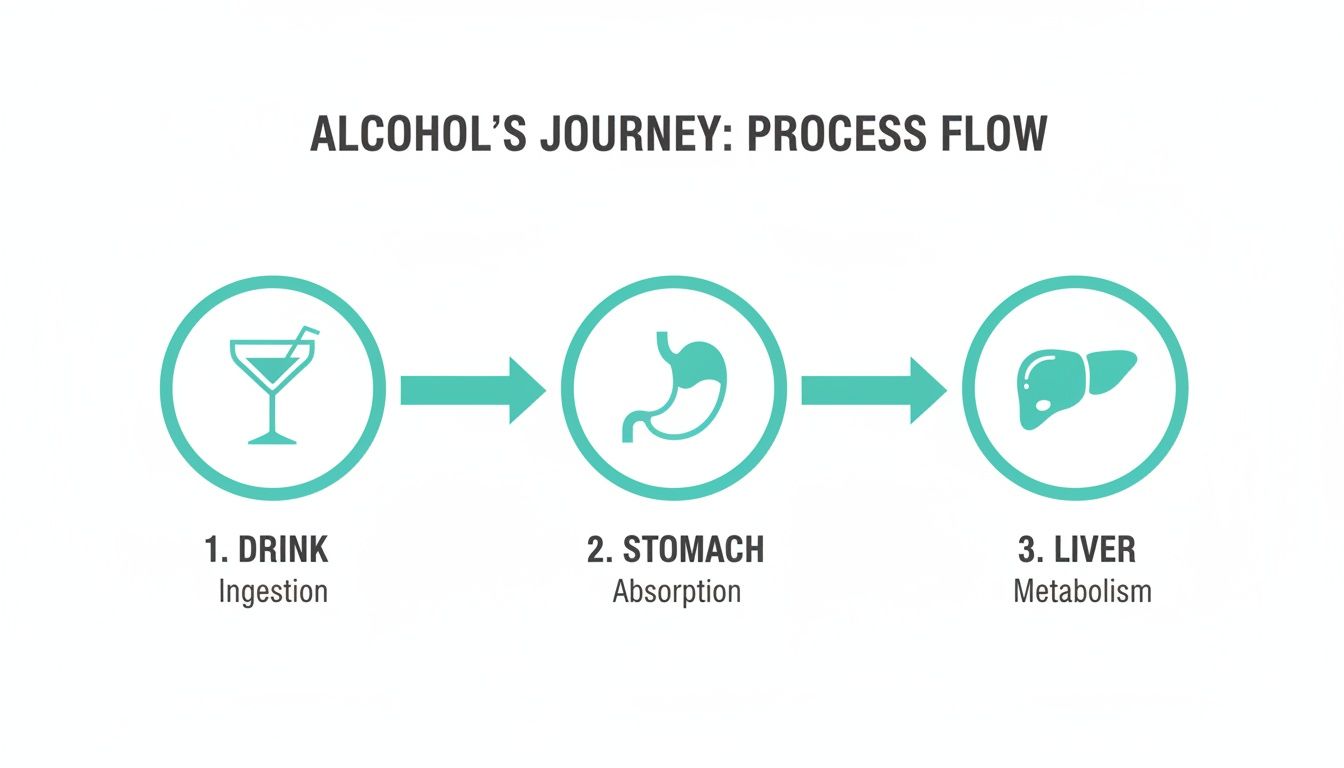
This whole system is designed to protect you, but it’s easy to overwhelm.
When you drink faster than your liver can keep up, that unprocessed alcohol just keeps circulating through your body. That’s what leads to increased intoxication and all the nasty side effects we’d rather avoid.
Before we dive deep into the science, here's a quick overview of the four main stages of alcohol processing. Think of it as a roadmap for the journey we're about to explore.
The Four Stages of Alcohol Processing At a Glance
| Stage | Primary Location | Key Action | Approximate Timeline |
|---|---|---|---|
| 1. Absorption | Stomach & Small Intestine | Alcohol enters the bloodstream. | 30-90 minutes |
| 2. Distribution | Bloodstream & Organs | Alcohol travels throughout the body. | Minutes after absorption |
| 3. Metabolism | Liver | Enzymes break down alcohol. | ~1 standard drink per hour |
| 4. Elimination | Kidneys, Lungs, Skin | Byproducts and unmetabolized alcohol are removed. | Ongoing, until BAC is zero |
This table gives you the big picture. Now, let’s get into the nitty-gritty of what’s happening at each stop and how you can support your body’s natural processes along the way.
Stage One: Absorption into the Bloodstream

From that very first sip, your body gets to work on processing alcohol with surprising speed. Unlike food, which has to go through a whole digestive ordeal, alcohol gets the VIP treatment—an express pass straight into your bloodstream. Its tiny molecules don't need to be broken down, so they can slip right through cell membranes.
This rapid entry starts in the stomach, where about 20% of the alcohol gets absorbed through the stomach lining. But the stomach is just the opening act. The real main event is the small intestine, which is built for maximum absorption. Its massive surface area is where the remaining 80% of the alcohol quickly enters your circulation.
This is a huge piece of the puzzle in understanding how the body processes alcohol, because the speed of absorption is what dictates how quickly you feel the effects.
Why You Should Never Drink on an Empty Stomach
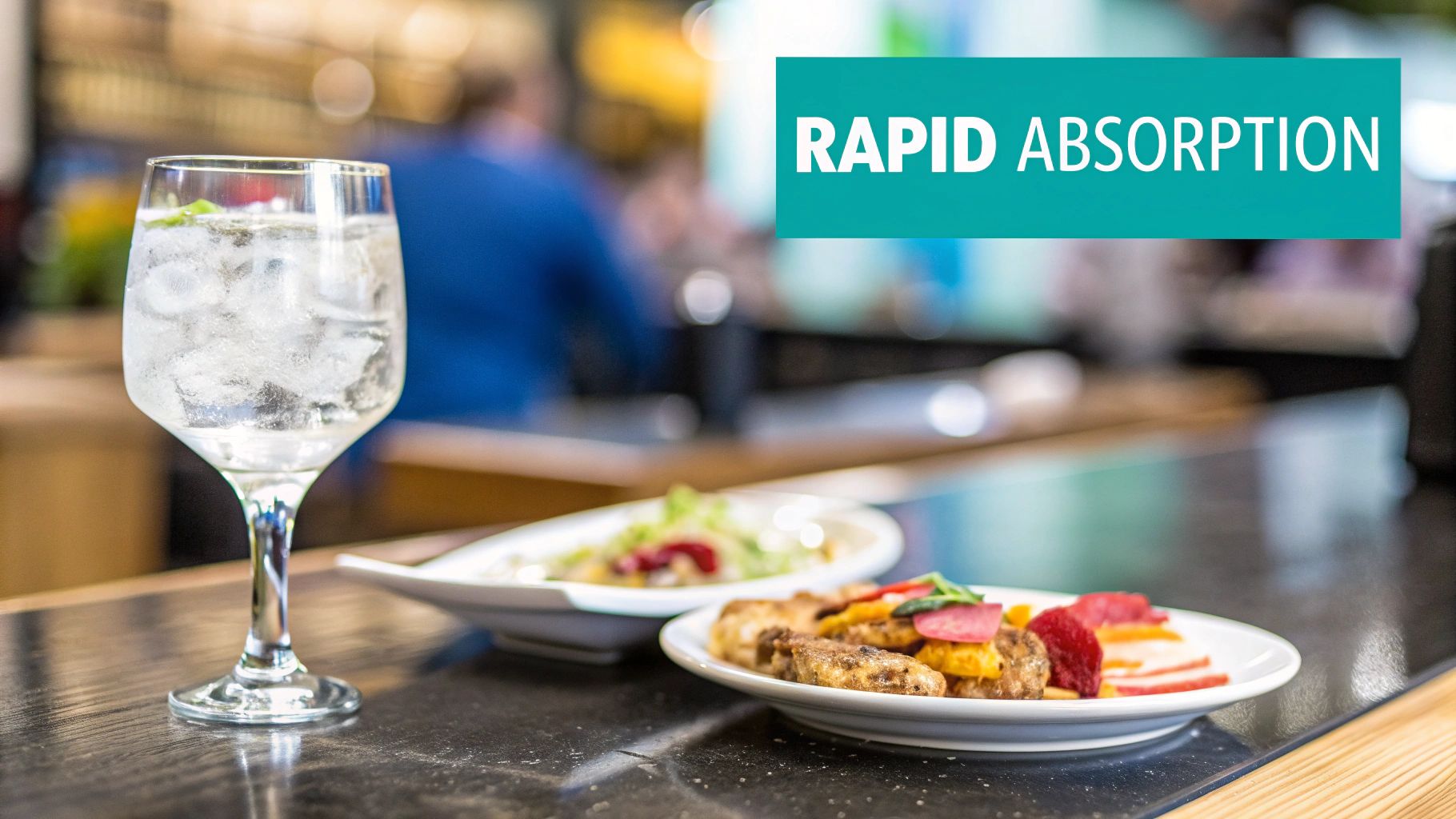
Think of the journey from your stomach to your small intestine like an express lane at an amusement park. When your stomach is empty, alcohol zips straight through to the small intestine, gets absorbed in a flash, and your Blood Alcohol Concentration (BAC) spikes hard and fast. That sudden rush is what leaves you feeling the effects much sooner and more intensely than you might have expected.
Now, imagine food is like a friendly gatekeeper controlling that express lane. Eating a solid meal—especially one with fats, proteins, and carbs—before you start drinking essentially closes that gate for a bit.
The pyloric sphincter, which is the muscular valve connecting your stomach and small intestine, holds food back to be digested. This simple action traps the alcohol in your stomach for longer, dramatically slowing down its race to the small intestine and, in turn, your bloodstream.
This delay doesn't stop the alcohol from getting absorbed, but it absolutely smooths out the process. It prevents that sudden, overwhelming spike in your BAC and gives your liver—the body's main detox center—a much-needed head start to do its job at a more manageable pace.
The Stomach's First Line of Defense
While the stomach is mostly a holding area, it does have one crucial trick up its sleeve called first-pass metabolism. This is where a special enzyme, gastric alcohol dehydrogenase (ADH), breaks down a small amount of alcohol before it even has a chance to enter your main circulatory system.
This preemptive strike actually lowers the total amount of alcohol that makes it into your bloodstream and heads to your liver. How well this first-pass metabolism works can be influenced by things like genetics and biological sex, which helps explain why two people can have completely different reactions to the exact same drink.
Picture yourself sipping a cocktail at a bar. Within minutes, that alcohol is on the move. While a small amount (20-25%) is absorbed in the stomach, the real action starts when the remaining 75-80% hits the small intestine and makes its way to the liver. Research shows that the average 70kg person metabolizes about 7 grams of pure alcohol an hour—roughly one standard drink. You can dive into the full study on alcohol absorption rates to see the science behind it.
Stage Two: The Liver's Two-Step Detoxification Process
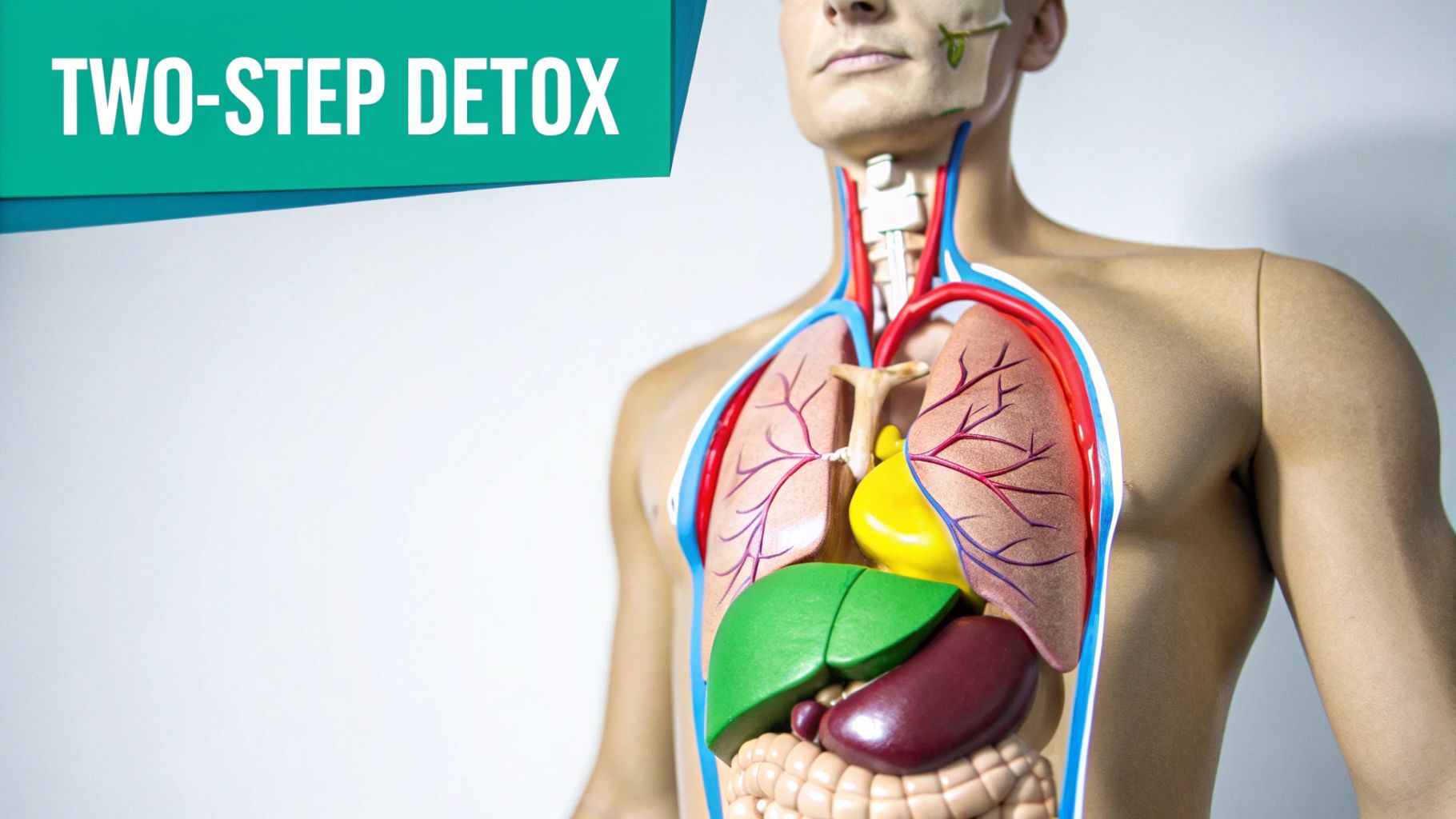
Once alcohol hits your bloodstream, it goes on a whirlwind tour of your body, reaching your brain and other organs in just a few minutes. But the real heavy lifting—the detoxification—happens when it arrives at its main processing plant: the liver. This incredible organ is the undisputed star of the show, breaking down the vast majority of the alcohol you drink.
But the liver doesn't just filter out alcohol. It carries out a complex, two-step chemical takedown to neutralize it. Think of it as a highly specialized assembly line built to dismantle a toxic substance, one piece at a time. Getting a handle on this process is key to understanding why you feel the way you do the next day.
The First Step: Meet the ADH Enzyme
The first and most important part of this detox involves an enzyme called alcohol dehydrogenase (ADH). The moment ethanol—the pure alcohol from your drink—shows up in the liver, ADH gets straight to work, chemically converting it into a totally new compound.
This new substance is called acetaldehyde. And while this step successfully dismantles the original alcohol molecule, it creates a brand new, and much more toxic, problem.
Think of the ADH enzyme as a bomb disposal expert. It successfully disarms the initial device (ethanol) but leaves behind some seriously volatile and hazardous materials (acetaldehyde). The immediate threat is gone, but the cleanup is just getting started, and the new mess is dangerous in its own right.
Acetaldehyde is a highly reactive and nasty chemical. It’s the primary culprit behind many of a hangover's worst symptoms, like nausea, headaches, and that notorious facial flushing some people get.
Acetaldehyde: The Real Villain of Hangovers
While ethanol gets you buzzed, acetaldehyde is the true antagonist in your hangover story. It’s a troublemaker that causes widespread inflammation and oxidative stress all over your body.
Here’s a quick rundown of the damage acetaldehyde leaves in its wake:
- Facial Flushing: It makes blood vessels dilate, causing that red, warm feeling in the face known as "alcohol flush."
- Headaches: This compound is a known contributor to those throbbing, next-day headaches.
- Nausea and Vomiting: It irritates the stomach lining, which is a fast track to feeling sick.
This toxic middleman doesn't hang around for long, but its impact is huge. How efficiently your body moves on to the next step determines just how much damage acetaldehyde can do before it's neutralized.
The Second Step: ALDH to the Rescue
Thankfully, your liver has a second, equally important enzyme ready to deal with the acetaldehyde problem. The hero of this part of the story is aldehyde dehydrogenase (ALDH).
As soon as acetaldehyde is formed, ALDH swoops in to convert it into a much safer substance called acetate. Acetate is basically vinegar—a harmless compound your body can easily break down into water and carbon dioxide, which you then eliminate.
This two-step process is a delicate balancing act. For your body to handle alcohol with minimal collateral damage, the ALDH enzyme has to work just as fast—if not faster—than the ADH enzyme. When it can't keep up, acetaldehyde starts to build up, and that’s when you really feel the consequences.
To make sense of it all, here's a simple breakdown of the main players in your liver's detox assembly line.
The Key Players in Alcohol Metabolism
| Molecule/Enzyme | Role in the Process | Health Impact |
|---|---|---|
| Alcohol Dehydrogenase (ADH) | The first enzyme. It converts ethanol into acetaldehyde. | Kicks off the detox process but creates a highly toxic byproduct. |
| Acetaldehyde | A toxic intermediate compound. | The main cause of hangover symptoms like flushing, nausea, and headaches. It’s also a known carcinogen. |
| Aldehyde Dehydrogenase (ALDH) | The second enzyme. It converts acetaldehyde into harmless acetate. | The hero that neutralizes the toxic acetaldehyde. Its efficiency is crucial for feeling okay the next day. |
| Acetate | The final, harmless byproduct. | Easily broken down into water and carbon dioxide, which are then eliminated from the body. |
This table really shows how the speed and efficiency of this system are what stand between you and a truly miserable morning.
The Genetic Factor in Alcohol Metabolism
Ever wondered why some people turn bright red and feel sick after just one drink? The answer is often in their genes, specifically the one that builds the ALDH enzyme.
This genetic difference makes the science of alcohol processing deeply personal. Around 30-50% of people of East Asian descent have a genetic variant that makes their ALDH enzyme sluggish. This slowdown causes acetaldehyde levels to skyrocket 5 to 10 times higher than normal.
To make matters worse, heavy drinking can fire up another enzyme, CYP2E1, which also creates acetaldehyde. This just adds more fuel to the fire, overwhelming a system that's already struggling to keep up. It’s a perfect example of how your unique biology dictates your experience with alcohol, proving that a one-size-fits-all approach to drinking just doesn’t exist.
Stage Three: The Unchangeable Rate of Elimination
After the liver finishes its two-step detox, the last stage is all about elimination. This is where a lot of the common myths about sobering up—like chugging coffee or taking an icy shower—completely fall apart.
The reality is much simpler, and unfortunately, much slower.
Your body’s ability to clear alcohol is dictated by a principle called zero-order kinetics. It sounds a bit academic, but the idea behind it is actually pretty straightforward.
Imagine your liver is a factory with a single conveyor belt that moves at one, unchangeable speed. No matter how many boxes (alcohol molecules) you pile on at the start of the line, that belt isn't going any faster. Your liver processes alcohol at a constant rate, and there’s really nothing you can do to speed it up.
The Unwavering Pace of Sobriety
This fixed metabolic rate is surprisingly consistent for most people. On average, your Blood Alcohol Concentration (BAC) drops by about 0.015% every hour. This single number is the key to understanding why patience is the only real cure for being drunk.
So, what does that 0.015% per hour rate look like in the real world?
- One Standard Drink: It takes your body about an hour to fully process the alcohol from one standard drink, like a 12 oz beer or a 5 oz glass of wine.
- A Few Drinks: If you have three drinks over a couple of hours, you’ll still need at least another three hours after you stop drinking for your liver to clear it all out.
- The Legal Limit: If you reach the common legal driving limit of 0.08% BAC, your body will need over five hours to get back to zero.
This predictable timeline is exactly why time is the only thing that truly sobers you up. That liver conveyor belt simply cannot be rushed.
The belief that you can "sober up" with a quick fix is one of the most stubborn myths out there. The truth is, while a stimulant like caffeine might make you feel more alert, it does absolutely nothing to lower your BAC or undo the physical impairment.
The Minor Exit Routes
While your liver is doing almost all of the heavy lifting (over 90%), a tiny bit of alcohol finds other ways out. A small amount of unmetabolized alcohol escapes directly through your breath, sweat, and urine.
This is exactly why breathalyzer tests work—they’re measuring the small fraction of alcohol that exits through your lungs.
But these other routes are just side streets compared to the metabolic superhighway running through your liver. They account for less than 10% of total elimination, so they don’t really speed up the overall process.
The body's elimination rate is a masterclass in predictability, clocking in at a consistent 0.015-0.016% BAC drop per hour for almost everyone. This fixed-rate reality underscores why no amount of coffee or a cold shower can sober you up; only time can. For a deeper dive, check out these insights on alcohol metabolism.
This unchangeable rate really drives home a critical point: being proactive is far more effective than trying to find a cure after the fact. Since you can't speed up the cleanup, the smartest move is to support your body's natural processes from the start and give it less of a mess to deal with later.
Factors Influencing How Your Body Handles Alcohol
Ever wondered why your friend can knock back three beers and feel totally fine, but you’re feeling woozy after just one? It’s not just about "tolerance." The real answer is a complex mix of personal factors that completely change how the body processes alcohol.
Think of your unique biology as a control panel with a bunch of dials. Each one—your genetics, your age, what you ate for dinner—can turn the speed and efficiency of your internal detox factory up or down. Understanding these variables is key, since they determine everything from how quickly you feel a buzz to how rough you feel the next morning.
Biological Sex and Body Composition
One of the biggest variables is biological sex. On average, women tend to hit a higher Blood Alcohol Concentration (BAC) than men after drinking the same amount, and the reasons are purely physiological.
First off, women generally have less body water than men of the same weight. Because alcohol is water-soluble, it ends up more concentrated in that smaller volume of fluid, leading to a higher BAC. It’s simple chemistry.
Men also typically have higher levels of an enzyme called alcohol dehydrogenase (ADH) in their stomachs. This lets them perform more "first-pass metabolism," essentially breaking down a chunk of the alcohol before it even hits the bloodstream. Women have less of this enzyme, so more pure alcohol gets absorbed, putting a bigger, more immediate load on the liver.
It's a matter of biochemistry, not behavior. A man and a woman of the same size can drink the exact same drink, but their bodies will process it differently right from the start.
The Role of Age and Genetics
Your age and your genes are two things you can’t change, but they have a massive impact on how you handle alcohol. As we get older, our body composition naturally shifts—we tend to lose muscle and gain fat. This reduces our body's water content, which can lead to higher BAC levels, much like the differences seen between sexes. On top of that, liver function can also become less efficient over time.
Genetics, though, can be an even bigger player. A classic example is the ALDH2 deficiency, which is common in people of East Asian descent. This genetic trait means you have a sluggish version of the aldehyde dehydrogenase enzyme—the crucial one that neutralizes the toxic byproduct, acetaldehyde.
- The Result: Acetaldehyde builds up fast, causing that tell-tale facial flushing, nausea, and a racing heartbeat.
- The Impact: This isn't just uncomfortable. It exposes the body to a highly toxic compound for longer, seriously dialing up the negative health effects.
This one genetic difference is a perfect illustration of how your personal biology completely dictates your experience with alcohol.
Food and Hydration Levels
Finally, what you eat and drink—besides the alcohol itself—has a direct and immediate effect. Drinking on an empty stomach is a fast pass for alcohol to get from the stomach to the small intestine, where it's absorbed at lightning speed. The result? A sharp, sudden BAC spike.
Eating a solid meal, especially one with fats, proteins, and carbs, slows down gastric emptying. This basically keeps the alcohol in your stomach longer, giving your stomach's ADH enzyme more time to work its magic and slowing the overall absorption rate.
Likewise, being dehydrated means there's less water in your body to dilute the alcohol, which can also lead to a higher BAC.
Party Smarter by Supporting Your Body's Natural Process
Once you understand the nuts and bolts of how your body handles alcohol, the science stops being abstract and starts feeling like practical wisdom. It’s the kind of knowledge that empowers you to make smarter choices that genuinely impact how you feel the next day. The journey is pretty clear: alcohol gets absorbed fast, and then it’s up to your liver to run its methodical, two-step detox process.
The single most important thing to remember is that your liver works at a fixed rate. You just can’t speed it up. Think of it like a dedicated factory worker who can only process about one standard drink per hour, no matter how much you try to rush them. This simple biological fact completely debunks the myth of "sobering up fast" and shifts the focus from useless morning-after "cures" to proactive, intelligent support.
Reinforce Your Body's Defenses
With this in mind, the best strategies become almost obvious. They aren’t groundbreaking secrets, just simple, science-backed actions that respect your body’s natural limits and help its detoxification pathways do their job.
- Eat First, Drink Later: Think of a good meal as a bouncer for your bloodstream. It slows down alcohol’s grand entrance, preventing that sudden, overwhelming spike in your BAC.
- Hydrate Relentlessly: Tossing back a glass of water between alcoholic drinks is a classic for a reason. It helps fight off dehydration and gives your body the liquid it needs to flush out all those nasty byproducts.
- Pace Yourself: Sticking to that one-drink-per-hour rule is a game-changer. It keeps you from overwhelming your liver’s capacity, which means less toxic acetaldehyde building up in your system.
This is exactly where a product like Upside fits so well into a healthier approach to socializing. It’s not some magic pill that promises to erase bad decisions or make you sober on the spot. Instead, it’s a support crew for your body, expertly formulated to help manage the biochemical chaos that drinking can cause. By delivering targeted nutrients and botanicals, Upside helps your system handle the oxidative stress and inflammation that alcohol leaves behind.
The goal isn’t to find a way to drink irresponsibly without consequences. The goal is to enjoy social occasions while minimizing the negative impact, allowing you to live more and regret less.
By truly getting the science behind how your body processes alcohol, you can completely change your approach to drinking. You move from just crossing your fingers and hoping for the best to actively supporting your body's built-in systems. This knowledge gives you back control, turning a night out into a smarter, more enjoyable experience—without paying for it the next morning.
For anyone looking to be even more prepared, exploring supplements to take before drinking alcohol can add another layer of support. At the end of the day, the message is one of empowerment: work with your body, not against it, and you’ll be rewarded with much better mornings.
Frequently Asked Questions
When you start digging into the science of how your body handles alcohol, a few questions always pop up. Let's walk through some of the most common ones to clear the air and maybe bust a few myths you’ve heard over the years.
Why Do I Feel So Much Worse After Drinking Certain Types of Alcohol?
Ever wondered why a few glasses of red wine can leave you feeling like you got hit by a truck, while the same amount of vodka goes down much easier? You can thank a group of chemical byproducts called congeners.
These little compounds are created during the fermentation and aging process, which is why they’re much more common in darker drinks like whiskey, brandy, and red wine. While your liver is busy metabolizing the ethanol, it also has to deal with these extra toxins. That extra workload can make hangover symptoms like headaches and nausea a whole lot worse, explaining why your drink of choice really does matter.
Does Building a Tolerance Change How My Body Processes Alcohol?
Yes, building a tolerance is a real thing, but it’s a bit more complicated than just being able to "hold your liquor." There are actually two different types of tolerance happening at once.
- Metabolic Tolerance: This is your liver getting a little more efficient. With regular heavy drinking, your liver can ramp up production of the enzymes it needs to break down alcohol, clearing it from your blood just a bit faster.
- Functional Tolerance: This is all about your brain adapting. Your central nervous system learns to function more or less normally even when alcohol is present. This is why you might feel less drunk than you actually are.
Here's the critical part: feeling less drunk doesn't mean your BAC is lower. Your body is still under the same—or even greater—strain. Functional tolerance is sneaky and can be dangerous because it might convince you to drink more than you should, putting your organs at serious risk.
Can I Speed Up Alcohol Metabolism to Dodge a Hangover?
This is the big one, the myth that just won't die. Despite the thousands of products and "hacks" out there promising to sober you up in a flash, the answer is a hard no. Your liver works at a steady, fixed pace, a principle called zero-order kinetics.
This means absolutely nothing—not a pot of coffee, a cold shower, or a greasy burger—can make your liver process alcohol any faster. While things like staying hydrated and eating well can definitely help you feel better and support your body's recovery, only time can actually lower your Blood Alcohol Concentration. It’s why being proactive is always a better strategy than looking for a quick fix the morning after.
So, How Does a Product Like Upside Hangover Jelly Actually Help?
This is a great question. If you can't speed up metabolism, what’s the point? It’s important to be crystal clear: Upside does not make your liver work faster or lower your BAC.
Instead, Upside is designed to help your body deal with the biochemical mess that drinking leaves behind. It delivers a targeted blend of natural ingredients to help replenish the nutrients and electrolytes you lose, while also helping to manage the inflammatory response caused by nasty byproducts like acetaldehyde. Think of it less as a "sober-up" button and more as a support system to help your body bounce back from the stress of a fun night out.
Ready to party smarter and give your body the backup it deserves? Upside Hangover Sticks are designed to help you enjoy your night without wrecking your next day.
Discover how Upside can help you live more at enjoyupside.com
#upside #enjoyupside #upsidejelly #livemore #hangovercure #hangoverprevention #fighthangovers #preventhangovers #HangoverRelief #MorningAfter #PartySmarter #HydrationStation #WellnessVibes #RecoverFaster #NoMoreHangovers #HealthyParty #HangoverHacks #FeelGoodMorning #NightlifeEssentials #HangoverFree #SupplementGoals #PostPartyPrep #GoodVibesOnly #HealthAndParty #HangoverHelper #UpsideToPartying