

· By Annemarie
How to Stay Focused at Work and Reclaim Your Productivity
Staying focused at work isn't a passive activity; it’s about actively managing interruptions and wrestling your attention back. Every little distraction—a notification, a "quick question" from a coworker—chips away at your mental resources and kills your productivity more than you'd think.
Confronting the Modern Distraction Epidemic
Let's be real: trying to focus in today's work environment can feel like swimming against the current. We're constantly getting pulled in a million different directions by emails, Slack messages, and colleagues who mean well but keep dropping by our desks.
Each interruption seems harmless on its own, but they add up. The result? A massive drain on your mental energy.
This constant task-switching creates something called attention residue. It's that mental fog that hangs around long after you've been pulled away from what you were doing. Your brain can't just slam the brakes on one thought and pivot to another instantly. Bits and pieces of the last task linger, making it impossible to fully lock in on the new one. This leads to sloppy work, higher stress, and that awful feeling of being busy all day but getting nothing done.
The True Cost of a Single Interruption
The damage from these interruptions goes way beyond the few seconds they take. Research shows that office workers are interrupted, on average, every three minutes.
Even more shocking? It takes roughly 23 minutes to fully get your focus back after just one interruption. That means a single "quick question" can obliterate nearly half an hour of productive, concentrated time.
A study on remote work found that employees who didn't have to deal with in-office interruptions gained about 29 minutes of productive time each day. The link is crystal clear: fewer interruptions lead to more focus.
Why Defending Your Focus Matters
Getting a handle on this reality is the first real step toward taking back your workday. This isn't about being rude or blowing off your responsibilities. It’s about understanding that deep, meaningful work requires an uninterrupted bubble.
These constant disruptions don't just make tasks drag on forever; they also increase the chance of making mistakes and are a major contributor to burnout. Learning to manage them is a huge part of good work stress management techniques. By actively protecting your focus, you create the space you need to produce your best work, lower your mental strain, and actually end the day feeling accomplished instead of just exhausted.
Designing Your Environment for Deep Concentration
Your surroundings—both the physical desk in front of you and the digital world on your screen—have a massive impact on your ability to focus. A messy desk, a cluttered desktop, and a phone that buzzes every few minutes are all subtle but powerful enemies of concentration.
The goal isn't to create some sterile, minimalist utopia. It's simply about removing the little bits of friction that pull you away from what's important. When your environment is built for focus, you spend less mental energy fighting off distractions and more of it on the actual work.
Taming Your Physical Workspace
Your immediate physical space sets the tone for your entire day. We’ve all been there—a desk covered in old coffee mugs and random papers just feels chaotic and makes it nearly impossible to settle into a state of flow. A clean, organized space, on the other hand, sends a clear signal to your brain: it's time to work.
Start with your desk. Clear everything off and only put back the absolute essentials you need within arm's reach. Think about your lighting; natural light is always the winner, but a decent desk lamp can do wonders for preventing eye strain and fatigue.
Noise is the next big hurdle. If you're in a busy office, a good pair of noise-canceling headphones is one of the best investments you can make for your productivity. Even just playing some ambient sounds or white noise can help you create a personal bubble of concentration.
Fortifying Your Digital Defenses
Let's be real: in today's world, digital distractions are often way more persistent than physical ones. Every notification is a potential focus-killer, and the siren song of social media is always just one click away. Getting a handle on your digital environment is non-negotiable if you’re serious about staying focused.
This means getting ruthless with your notifications. Seriously, turn off everything that isn't absolutely critical on your phone and computer. Start using "Do Not Disturb" or "Focus Mode" like it's your job during your work blocks.
The most effective digital environments are built on intention. Instead of reacting to every ping and alert, you proactively decide what deserves your attention and when. This shift from a reactive to a proactive mindset is a game-changer for productivity.
The flowchart below shows just how devastating a single interruption can be, which really drives home why these digital boundaries are so important.
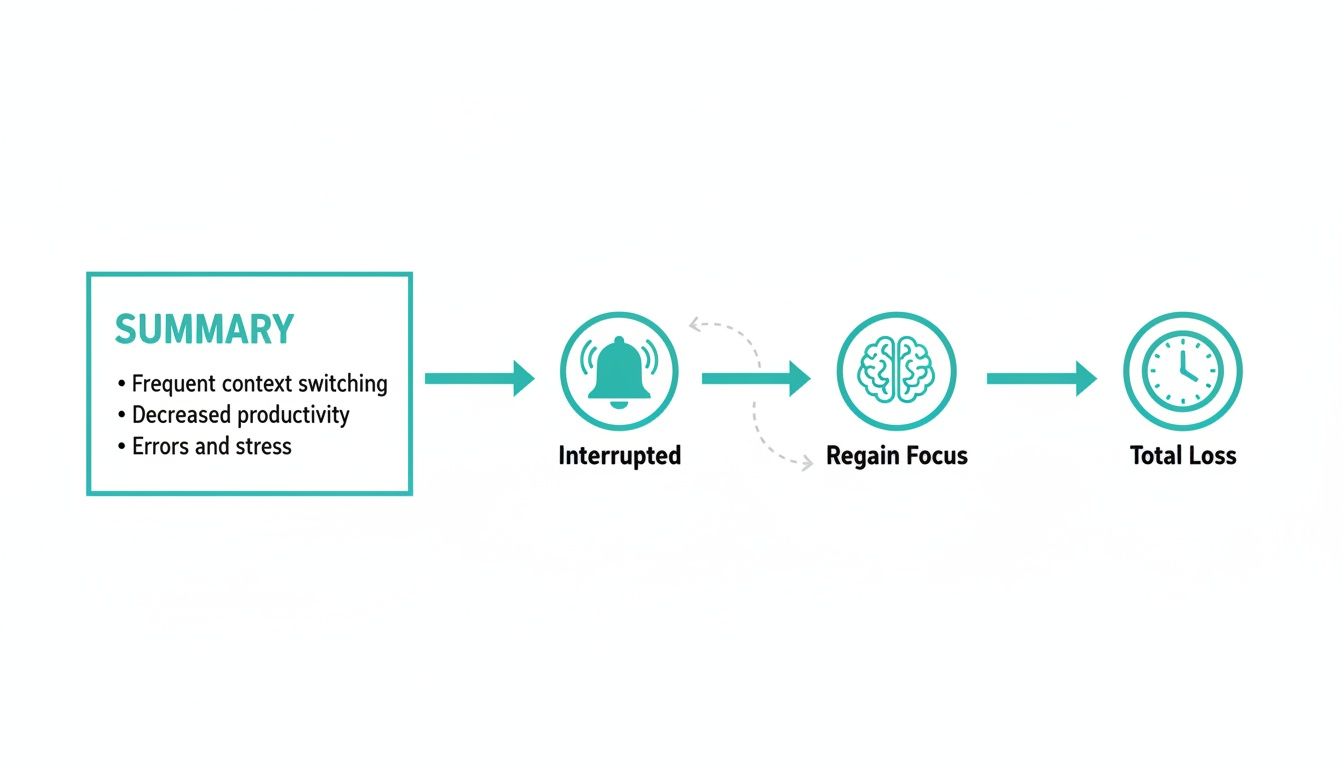
What this really shows is that the true cost of an interruption isn't just the few seconds it takes to read a message. It's the 20+ minutes your brain needs to fully recover and get back into a deep state of work.
To take it a step further, here are some strategies I've found incredibly effective for minimizing digital noise:
- Website Blockers: Apps like Freedom or Cold Turkey are fantastic. You can block distracting websites for set periods, completely removing the temptation to "just check" Twitter.
- Dedicated Work Profiles: This one is a bit more involved but so worth it. Create a separate user profile on your computer just for work. No personal bookmarks, no distracting apps, no family photos on the desktop. It keeps your work-life and home-life neatly separated.
- Smarter Email Habits: Don't leave your inbox open all day. That's just asking for trouble. Instead, schedule specific times—maybe once in the morning and once in the afternoon—to check and respond to emails. This stops your inbox from dictating your day.
Optimizing both your physical and digital spaces is a powerful one-two punch for concentration. Here’s a quick breakdown of how to approach both.
Digital vs Physical Focus Environment Setup
This table compares some key strategies for getting both your digital and physical workspaces in order to support deep concentration.
| Focus Area | Digital Optimization Strategy | Physical Optimization Strategy |
|---|---|---|
| Clutter Control | Organize desktop files into folders. Close unused browser tabs and applications. | Keep only essential items on your desk. Use drawers and shelves for storage. |
| Distraction Management | Turn off non-essential notifications. Use website and app blockers. | Use noise-canceling headphones. Position your desk away from high-traffic areas. |
| Ergonomics & Comfort | Adjust screen brightness and use blue light filters to reduce eye strain. | Invest in an ergonomic chair, monitor stand, and proper lighting. |
| Boundary Setting | Create separate user profiles for work and personal use. Set "Do Not Disturb" hours. | Use a "busy" sign or signal to coworkers when you need uninterrupted time. |
By being intentional about tidying up both your desk and your desktop, you're creating a sanctuary that supports your focus instead of constantly fighting against it.
Mastering Your Time with Proven Focus Frameworks
Trying to rely on sheer willpower to stay focused is like trying to hold back a flood with your bare hands. It's an exhausting, losing battle. A much better approach is to adopt a system—a proven framework that protects your attention and gives your day some much-needed structure.
These methods aren't about working harder. They're about working smarter by creating intentional boundaries for your time and energy.
One of the simplest yet most powerful frameworks is the Pomodoro Technique. The idea is straightforward: you work in hyper-focused, 25-minute sprints, then take a short 5-minute break. After four of these cycles, you reward yourself with a longer break, maybe 15-30 minutes.
The psychology here is surprisingly effective. Those short, timed bursts create just enough urgency to help you push past distractions. Meanwhile, the built-in breaks are your secret weapon against mental fatigue and burnout. It takes a huge, intimidating project and chops it down into a series of manageable little chunks, which makes it so much easier to get started and keep the momentum going.
Implement Time Blocking for Ultimate Control
While Pomodoro is great for managing individual tasks, time blocking helps you organize your entire day. With this method, you literally schedule blocks of time in your calendar for everything you need to do—from answering emails to deep-diving into a major report. You’re trading a vague to-do list for a concrete plan of action.
A project manager, for example, might block off 9:00 AM to 10:00 AM for team check-ins. The next two hours, 10:00 AM to 12:00 PM, are reserved for focused work on project timelines. After lunch, they might block out another hour just to clear their inbox.
By assigning a job to every minute of your day, you eliminate the guesswork and decision fatigue that so often leads to procrastination. It’s a proactive approach that puts you in control of your schedule, rather than letting your schedule control you.
This kind of structure is also a game-changer when you're trying to figure out how to maintain work-life balance, since it creates very clear start and end points for your workday.
Carve Out Time for Deep Work
Some tasks just need more than a 25-minute sprint. They demand long, uninterrupted stretches of intense concentration. This is where the idea of deep work comes into play. It’s all about scheduling significant, distraction-free blocks—usually 90 minutes or more—to tackle your most brain-draining work.
Here are a few practical ways to get started with deep work:
- Schedule It Like a Meeting: Put these blocks directly into your calendar and treat them like non-negotiable appointments. No excuses.
- Go Completely Offline: This is key. Close your email, sign out of Slack, and put your phone in another room. The goal is to be totally unreachable.
- Signal Your Status: Let your team know you’re in a deep work session and when you'll be available again. A simple status update can prevent a lot of interruptions.
Imagine you're a graphic designer working on a complex branding project. A three-hour deep work session first thing in the morning is likely where your most creative, valuable ideas will come to life. By combining these different frameworks, you build a resilient system that helps you stay on track and produce your best work, day in and day out.
Fueling Your Brain for Sustained Performance

Let’s be real, staying focused isn't just a mental game—it's a biological one. What you put into your body has a direct line to your brain's ability to concentrate, solve problems, and just get through the day without zoning out. Think of your brain as a high-performance engine; you wouldn't fill it with junk fuel and expect it to run well, right?
We've all been there. You grab a sugary snack or a pastry for a quick energy boost, and for a glorious 30 minutes, you feel on top of the world. Then comes the crash. That's the classic mid-afternoon slump, where your brain feels like it’s wading through mud and your motivation takes a nosedive.
The good news is you can get ahead of this. By loading up your diet with nutrient-packed "brain foods," you give your mind the steady, reliable energy it needs to really perform. Even small, deliberate tweaks to your meals can make a huge difference.
Smart Nutrition for a Sharper Mind
Choosing the right food isn’t just about health; it's a productivity strategy. You want to aim for a mix of complex carbs, healthy fats, and lean proteins. This trifecta ensures a slow, steady release of glucose—your brain's favorite food—so you can avoid those jarring energy spikes and slumps.
Here are a few powerhouse options to add to your grocery list:
- Omega-3 Fatty Acids: Think fatty fish like salmon, or plant-based sources like walnuts and flaxseeds. These are the literal building blocks for your brain and nerve cells.
- Antioxidants: Berries, dark chocolate (yes, chocolate!), and leafy greens like spinach are fantastic for protecting your brain cells from stress.
- Complex Carbs: Swap the white bread for oatmeal and whole grains. They provide energy that lasts for hours, not minutes.
A well-fed brain is a focused brain. Swapping a bag of chips for a handful of almonds isn't just a "healthier" choice—it's a direct investment in your ability to crush your to-do list for the rest of the afternoon.
The Critical Role of Hydration and Sleep
Okay, so food is covered. But that's only part of the story. You could have the perfect diet, but if you’re dehydrated, your brain will struggle. Even being a little low on H2O can mess with your memory and concentration. The easiest fix? Keep a water bottle on your desk at all times.
And finally, let's talk about the non-negotiable: sleep. Sleep is when your brain does its nightly housekeeping—clearing out toxins, organizing memories, and basically hitting the reset button. Skimping on sleep is like starting a marathon with your shoes tied together. Every single task just feels harder. For a deeper dive, check out our guide on how to boost energy naturally to build on these habits.
Locking in your sleep hygiene is a game-changer. Try to stick to a consistent bedtime, cut down on screen time before bed, and make sure your room is dark and cool. When you prioritize good rest, you’re not just fighting off tiredness; you're sharpening the most powerful tool you have for staying focused.
Building the Habits and Routines of Lasting Focus
Motivation is a great way to get started, but let's be honest, it's a terrible long-term fuel for productivity. It comes and goes. The real secret to staying focused at work isn’t about forcing yourself to concentrate—it’s about building systems that make it happen almost automatically.
These routines act like guardrails for your day. They keep you on track even when you’re tired, uninspired, or just plain don’t feel like it. Instead of burning through willpower, you’re leaning on a structure you’ve already built to do the heavy lifting for you.
Architecting Your Morning for Momentum
How you start your morning can make or break the rest of your day. A solid morning routine isn't about cramming more stuff into your schedule. It’s about creating a simple, predictable sequence that primes your brain for focus before the chaos of the outside world rushes in.
So, instead of rolling over and grabbing your phone to scroll through a flood of emails and notifications, try carving out a small, screen-free window for yourself. It could be 10 minutes of journaling, a quick walk around the block, or just quietly enjoying a cup of coffee while you map out your top three priorities. This tiny buffer creates a sense of calm and control you can carry into your first big task.
Integrating Focus with Habit Stacking
Trying to build a brand-new habit from scratch is tough. There’s a much easier way: habit stacking. The idea is simple—you just link a new behavior you want to do with a habit you already do without thinking.
This technique, which author James Clear talks about extensively, practically eliminates the friction of starting something new. You just create simple "if-then" rules.
- After I pour my morning coffee, I will spend five minutes planning my workday.
- When I get back from my lunch break, I will put my phone in a drawer before starting my next task.
- Before I shut down my laptop for the night, I will clear my desk for tomorrow.
By piggybacking onto existing habits, you make it so much easier to weave these focus-boosting actions into your day without it feeling like another chore.
True focus isn't a single Herculean effort. It's the quiet result of a consistent system. When you build routines that automate good decisions, you save your precious willpower for the creative, complex work that actually moves the needle.
The Power of a Shutdown Ritual
Just as important as how you start your day is how you end it. A shutdown ritual is a clear, step-by-step process that tells your brain, "Okay, the workday is officially over." This is absolutely crucial for preventing burnout and making sure you can actually unplug and recharge.
Your ritual could be as simple as checking your calendar for the next day, jotting down any open loops so they aren't rattling around in your head all night, and closing every single work-related tab. It's a small act that creates a massive mental boundary between your work life and your personal life.
This structured ending doesn't just help you relax; it also tackles a huge cause of disengagement. A 2024 Gallup report estimated that only 21% of global workers feel engaged, a problem that costs the economy billions. Engaged people are focused people, and setting clear boundaries with a solid routine is one of the best ways to foster that engagement. You can dive deeper into the connection between engagement and productivity with these insights from Archie.
Got Questions About Focus? We’ve Got Answers.
Even when you’ve got a solid focus strategy, the real world has a funny way of throwing curveballs. A chatty coworker, a noisy open office, the siren song of your phone—it’s easy to get derailed. Let's tackle some of the most common focus-killers people run into at work.
Most of the time, the solution boils down to setting clear, respectful boundaries and learning how to communicate what you need to get your work done.
How Do I Handle Talkative Coworkers Without Being Rude?
Ah, the classic focus-killer. We've all been there. The key is to be polite but firm. You need to set a boundary that protects your concentration and your relationship with your colleague. You don’t have to be a jerk to protect your time.
Instead of just dropping hints and hoping they’ll get the message, try a gentle but direct approach. Something like, "I'd love to catch up on this, but I'm totally slammed with a deadline right now. Can we grab 15 minutes at lunch?" This acknowledges them but politely pushes the conversation to a better time.
A great pro-tip? Noise-canceling headphones are a powerful visual cue. They signal "do not disturb" without you ever having to say a word. It's the universal sign for deep work.
What’s the Best Way to Focus in an Open-Plan Office?
Open offices are great for collaboration, but let's be honest—they can be a complete nightmare for concentration. Since you can’t control the whole environment, you have to build your own little "focus bubble." This takes a mix of physical tricks and smart scheduling.
Here are a few tactics that actually work in a busy office:
- Find Your Power Hours: Figure out when the office is naturally quieter. Is it early in the morning before the rush, or later in the afternoon? Block out those golden hours for your most demanding tasks.
- Book a Room: If your office has breakout rooms or phone booths, use them! Book one for an hour and treat it like a meeting with your most important project. Don't be shy about it.
- Face a Wall: This sounds simple, but it works. If you can, angle your desk so you’re facing away from major foot traffic and visual distractions. Just reducing the amount of movement in your peripheral vision can make a huge difference.
How Can I Stop Myself From Constantly Checking My Phone?
Your smartphone is literally engineered to steal your attention. Getting that focus back means making your phone less tempting and harder to reach during your work blocks. It’s all about creating distance, both physically and digitally.
Try putting your phone on silent and stashing it in a drawer or your bag—anywhere you can’t see it or mindlessly grab it. If "out of sight, out of mind" isn't enough, there are plenty of focus apps that will block the distracting stuff for you. By adding that little bit of friction, you break the habit of the mindless scroll, which is a huge step in taking back your workday.
When the workday is done, it's time to unwind and celebrate your productivity. With Upside, you can enjoy your evening without worrying about the next morning. Our natural, great-tasting jelly sticks are designed to help you party smarter and feel your best, making it easy to maintain balance.
Live your life to the fullest and discover Upside today.
#upside #enjoyupside #upsidejelly #livemore #hangovercure #hangoverprevention #fighthangovers #preventhangovers #HangoverRelief #MorningAfter #PartySmarter #HydrationStation #WellnessVibes #RecoverFaster #NoMoreHangovers #HealthyParty #HangoverHacks #FeelGoodMorning #NightlifeEssentials #HangoverFree #SupplementGoals #PostPartyPrep #GoodVibesOnly #HealthAndParty #HangoverHelper #UpsideToPartying